























Call us
Call us
 FOR EXISTING POLICY
Have query on premium, payout or any servicing need?
Call us:
 FOR NEW POLICY
Want to buy a new policy online?
FOR NEW POLICY
Want to buy a new policy online?
FOR NEW POLICY (NRIs)
Thank you for sharing your details. To receive a call from Tata AIA Financial Advisor.
reCAPTCHA is not working.
No relevant search results found.
A 25-year ULIP policy combines insurance protection with investment opportunities in market-linked5 funds. When you pay your premium, ... Read more a portion covers life insurance, while the remainder gets invested in equity or debt funds based on your selection. The extended duration of 25 years allows investments to grow through compounding while providing financial protection to your family. These policies offer features such as flexible fund switching, tax2 benefits, and alignment with financial goals like retirement planning or education funding. In this article, we will see how ULIP returns in 25 years may impact investors and the various factors that influence their performance over time. Read less
A 25-year ULIP policy combines insurance protection with investment opportunities in .. Read more market-linked5 funds. When you pay your premium, a portion covers life insurance, while the remainder gets invested in equity or debt funds based on your selection. The extended duration of 25 years allows investments to grow through compounding while providing financial protection to your family. These policies offer features such as flexible fund switching, tax2 benefits, and alignment with financial goals like retirement planning or education funding. In this article, we will see how ULIP returns in 25 years may impact investors and the various factors that influence their performance over time. Read less
Your premium calculation is in progress
Kindly enter the OTP sent to
Please enter valid OTP
01:60
Didn't receive OTP?

Premier SIP Calculator
Pay (Total)


₹11,99,016
Get Maturity Benefit
Based on assumed rate of return
₹34.57 Lakh
As per actual past performance
₹70.50 Lakh
@20.37%Additional Benefits

Life Cover (including Terminal Illness Cover): ₹21.7 Lakh

Accidental Death Cover: ₹10.9 Lakh

Accidental Total & Permanent Disability: ₹10.9 Lakh
Discounts
1% discount on 1st year premium for all payments paid through any permissible electronic mode debited through an auto-debit mandate. Maximum discount capping: ₹100 over the year.
Applicable if the policy is purchased digitally.
This discount is auto-applied and can't be removed
Buy Now
Tata AIA Premier SIP is a combination of the Tata AIA Smart SIP - Non-participating, Unit-linked, Individual Life Insurance Savings Plan (UIN: 110L174V01) and
Tata AIA Health Buddy - Non-participating, Non-Linked, Individual Health Product (UIN:110N183V01). Both Tata AIA Smart SIP and Tata AIA Health Buddy are also available for sale individually. Product option: Future Secure
A 25-year ULIP is an insurance plan with a tenure of twenty-five years, containing both life coverage and investment components. The structure works like this: when you pay the premium, one portion covers the insurance aspect; the remaining amount is invested in funds of your choice.
You can choose between equity funds, debt funds, or a mix of both, depending on your risk tolerance and financial goals. The policy structure allows for fund switching as circumstances change. After the initial five-year lock-in period, partial withdrawals become available if required. The basic structure of this scheme is to create a corpus during the policy term while keeping life cover throughout.
A 25-year ULIP policy combines protection with investment opportunities. A part of the premium goes toward funding life insurance for a safety net, while the remaining amount is invested in market-linked5 investments through equity, debt, or both. Over a long-term perspective, ULIP returns in the last 25 years may help achieve reasonable growth.
For instance, if yearly investment is ₹80,000 with 40% allocated to debt funds and 60% in equity funds, it may increase to approximately ₹58.48 Lakh after a period of 25 years at an average return of 8% against total investment of ₹20 Lakh. This shows the potential that ULIPs have in accumulating corpus for the fulfilment of long-term financial goals.
Note: These figures are illustrative and could be different depending on market performance and returns from the fund.
Returns as on
Here is why you should choose a 10-year ULIP policy:
The policy provides life insurance coverage to protect your family's financial future against unexpected events. Your loved ones receive the sum assured amount if you die during the policy term.
ULIPs invest in equities and debt instruments, which have the potential to yield higher returns than conventional savings. A market-linked5 investment helps your funds grow fast with the long investment tenure of ten years.
You can select an investment option and switch funds depending on your goal and market trends. This allows you to revise your strategy to enhance returns and manage risks throughout the tenure.
The premium you pay is eligible for tax2 deduction under Section 80C of the Income Tax Act 1961. Additionally, the maturity proceeds are exempted under Section 10(10D) if all the conditions are met. For all the ULIP plans, irrespective of the premium amount or policy terms, the death benefit is exempt.
Long investment periods deliver potential returns due to the compounding effect and market cycle averaging throughout the tenure. A 10-year ULIP provides sufficient time to build a substantial corpus for important life goals.
Amounts are based on a 20-year-old non-smoker male, with a 20-year premium payment term and a 30-year policy term, Tata AIA Premier SIP Future Secure plan option with 100% invested in Tata AIA Multi Cap Fund at 8% Rate of Return. Returns at 4% for investment of ₹5000/month, ₹10,000/month, ₹15,000/month and ₹20,000/month are 24 Lakh, 49 Lakh, 73 Lakh and 98 Lakh respectively.
The following are important factors that affect ULIP’s performance over ten years:
Let us examine three scenarios based on an ₹80,000 annual investment in different fund types systematically.
Equity fund returns
Annual Investment: ₹80,000
Expected Annual Return Rate: 12%
Investment Period: 10 years
Using the future value formula
FV = P × [(1+r)ⁿ - 1] / r
Future Value = 80,000 × [(1+0.12)¹⁰ - 1] / 0.12
Projected Corpus: ₹14,03,899
Debt fund returns
Annual Investment: ₹80,000
Expected Annual Return Rate: 7%
Investment Period: 10 years
Using the future value formula
FV = P × [(1+r)ⁿ - 1] / r
Future Value = 80,000 × [(1+0.07)¹⁰ - 1] / 0.07
Projected Corpus: ₹11,05,316
Balanced Fund Returns
Annual Investment: ₹80,000
Expected Annual Return Rate: 9%
Investment Period: 10 years
Using the future value formula
FV = P × [(1+r)ⁿ - 1] / r
Future Value = 80,000 × [(1+0.09)¹⁰ - 1] / 0.09
Projected Corpus: ₹12,15,434
These projections may help you understand how different fund choices significantly impact your returns after ten investment years.
Here is how 10-year ULIP policy return rates are calculated:
Your premium amount gets allocated to chosen fund units after deducting applicable policy charges and fees. You can select equity funds, debt funds, or a mix of both based on risk appetite. Fund switching is allowed during the policy term to adjust allocation according to market performance changes.
Net Asset Value is the price of one unit of a particular fund at any given time. The NAV varies each day with market performance and is determined by applying the following standard formula:
NAV = (Market Value of Assets - Liabilities) / Total Outstanding Units
Liabilities include various policy expenses, charges, and fund management fees deducted from total assets.
WThe compound annual growth rate method computes your average annual return over the ten-year investment period.
CAGR Formula = [(Current NAV / Initial NAV) ^ (1 / Number of Years) - 1] × 100
Current NAV is the fund value at the end of ten years of your investment journey. Initial NAV is the fund value on your policy purchase date when the investment started initially.
You can choose between a single premium or a regular premium according to your financial situation. You have the option to make top-up payments anytime during the tenure to increase the investment amount. Also, partial withdrawals are allowed after completion of the mandatory five-year lock-in period.
The following are some ways to maximise your ULIP returns in 10 years.
Our experts are happy to help you!
Our experts are happy to help you!
A 10-year ULIP is an effective way to build wealth while protecting your family's financial future. Combining the dual benefit of market-linked5 growth potential with life insurance coverage, it helps in meeting your long-term financial goals. The right fund selection, discipline, and periodic monitoring are all important parameters for maximising returns over the decade. Understanding how charges, market cycles, and compounding work together enables sound investment decisions for optimal outcomes. Consider your risk tolerance and financial goals before investing in a 10-year ULIP plan.
1.
Yes, you can withdraw after the 5-year lock-in period, but early withdrawals may result in reduced long-term growth.
2.
ULIP returns fluctuate with market movement. Strong markets generally boost growth, while weak phases reduce performance. Long-term holding usually smooths short-term volatility.
3.
ULIPs can support long-term needs like education or retirement, but estimating the required contribution through a ULIP calculator helps align your goals and expectations.
4.
Past ULIP results offer useful guidance; however, they cannot assure future outcomes. Regular reviews and timely fund switches may help you align the plan with your goals and risk tolerance.
5.
Some equity-oriented ULIPs have provided substantial long-term gains, but the results depend upon the fund chosen, market cycles, and regular investing.
6.
You can follow your ULIP through NAV updates, fund reports, and online dashboards. Periodic monitoring of fund allocation and charges can support better decision-making.
7.
ULIP maturity proceeds may be exempt under Section 10(10D) if policy conditions are met, as per prevailing tax2 laws and eligibility.
Tata AIA Premier SIP is a combination of the Tata AIA Smart SIP, a non-participating, unit-linked, individual life insurance savings plan (UIN: 110L174V02), and Tata AIA Health Buddy, Non-participating, Non-Linked, Individual Health Product (UIN:110N183V01). Both Tata AIA Smart SIP and Tata AIA Health Buddy are also available for sale individually.
This advertisement is designed for combination of benefits of following individual and separate products named (1) Tata AIA Smart Sampoorna Raksha Supreme Unit Linked, Non-Participating Individual Life Insurance Plan (UIN: 110L179V02) and (2) Tata AIA Health Buddy, Non-Participating, Non-Linked, Individual Health Product (UIN: 110N183V01). These products are also available for sale individually without the combination offered/ suggested.
1Illustration shows a monthly premium of ₹20,000 for Tata AIA Premier SIP for a 30-year-old male, standard life, premium payment term: 10 years, policy term: 10 years with 100% investment in Tata AIA Multi Cap Fund in Future Secure plan option. 4% and 8% are assumed rates of return. 19.87% is the 5-year return of Nifty 500 Index as of October'25. Maturity amount: ₹25,86,726 at 4% returns, ₹31,74,241 at 8% returns and ₹ 59,28,633 at 19.87% returns. The fund value calculation is done by projecting the past returns of Nifty 500 Index after adjusting for all expenses in Tata AIA Premier SIP. The above values have been calculated assuming 19.87% p.a. gross investment returns, which is the past 5-year return of Nifty 500 Index as of October'25.
2No Goods and Service Tax shall be applicable on Individual life insurance products as per prevailing laws. Income Tax benefits would be available as per the prevailing income tax laws, subject to fulfillment of conditions stipulated therein. The Tax-Free income is subject to conditions specified under section 10(10D) and other applicable provisions of the Income Tax Act,1961. Tata AIA Life Insurance Company Ltd. does not assume responsibility on tax implications mentioned anywhere on this site. Please consult your own tax consultant to know the tax benefits available to you.
3All funds open for new business which have completed 5 years since inception are rated 4 star or 5 star by Morningstar as of August 2025.
©2025 Morningstar. All rights reserved. The Morningstar name is a registered trademark of Morningstar, Inc. in India and other jurisdictions. The information contained here: (1) includes the proprietary information of Morningstar, Inc. and its affiliates, including, without limitation, Morningstar India Private Limited (“Morningstar”); (2) may not be copied, redistributed or used, by any means, in whole or in part, without the prior, written consent of Morningstar; (3) is not warranted to be complete, accurate or timely; and (4) may be drawn from data published on various dates and procured from various sources and (5) shall not be construed as an offer to buy or sell any security or other investment vehicle. Neither Morningstar, Inc. nor any of its affiliates (including, without limitation, Morningstar) nor any of their officers, directors, employees, associates or agents shall be responsible or liable for any trading decisions, damages or other losses resulting directly or indirectly from the information.
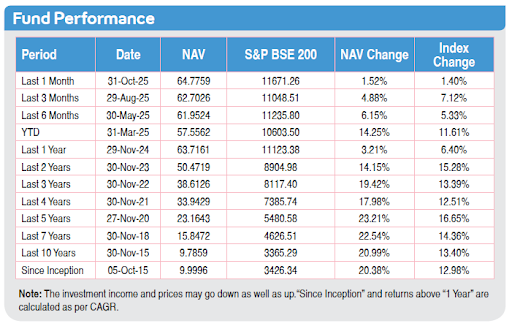
45-year computed NAV for Multi Cap Fund as of November 2025. Other funds are also available. Benchmark of this fund is S&P BSE 200.
5Market-linked returns are subject to market risks and terms & conditions of the product. The assumed rate of returns or illustrated amount may not be guaranteed and depends on market fluctuations
Linked Life Insurance products are different from traditional insurance products and are subject to risk factors.
The premium paid in Linked Life Insurance policies is subject to investment risks associated with capital markets and publicly available index. The NAV of the units may go up or down based on the performance of Fund and factors influencing the capital market/publicly available index and the insured is responsible for his/her decisions.
Tata AIA Life Insurance Company Limited is only the name of the Insurance Company & Tata AIA Smart Sampoorna Raksha Supreme, Tata AIA Smart SIP are only the names of the Unit Linked Life Insurance contract and does not in any way indicate the quality of the contract, its future prospects or returns.
Please know the associated risks and the applicable charges, from your insurance agent or the Intermediary or policy document issued by the insurance company.
The various funds offered under this contract are the names of the funds and do not in any way indicate the quality of these plans, their future prospects and returns.
Past performance is not indicative of future performance.
If your policy offers variable benefits, then the illustrations on this page will show two different rates of assumed future investment returns. Currently the gross investment returns are stipulated as 4% p.a. and 8% p.a. These assumed rates of return are not guaranteed, and these are not the upper or lower limits of what you might get back, as the value of your policy is dependent on a number of factors including actual future investment performance.
For more details on risk factors, terms and conditions please read Sales Brochure carefully before concluding a sale. Insurance cover is available under this product.
L&C/Advt/2026/Jan/0140








 No Premium Allocation charges


 Begin your investment early: Starting early provides more time to grow and capitalise on the compounding effect significantly. Early investment helps you accumulate a significant corpus even with small premium amounts over the decade.