
















Call us
Call us
 FOR EXISTING POLICY
Have query on premium, payout or any servicing need?
Call us:
 FOR NEW POLICY
Want to buy a new policy online?
FOR NEW POLICY
Want to buy a new policy online?
FOR NEW POLICY (NRIs)
Note: Consent is provided to Tata AIA Life Insurance Company Limited to contact you by calling/giving missed call to the above numbers.
Thank you for sharing your details. To receive a call from Tata AIA Financial Advisor.
reCAPTCHA is not working.
No relevant search results found.
Popular searches
Continue from where you left of
A term insurance plan with return of premium helps protect your family's financial future while offering added financial reassurance.... Read more It provides life cover during the policy term and refunds the total base premiums paid if you outlive the policy, and no claim is made, subject to the policy terms and conditions. Also known as a TROP, it is suitable for individuals seeking long-term protection with the added comfort of premium recovery. Read less
Kindly enter the OTP sent to
Please enter valid OTP
01:60
Didn't receive OTP?
Technical issue detected
please continue without OTP verification
Your premium calculation is in progress

Your details have been successfully submitted. A representative from Tata AIA Life Insurance will call you soon.
Your details could not be saved.
Please try again.

Rated by 1,28,237 customers
Data as of 6th July 2026, 4.6/5 from 1.25 lakh+ ratings across Android and iOS Tata AIA app.
120 year old female (Standard Life, Non-Smoker), regular pay, 40-year policy term. 3T&C Apply
Get Life Cover of ₹1 Crore by paying a premium of
₹7,085/month
Total premium: ₹14.09 Lakh
 Save ₹1,202 with discounts
Discounts
10% discount on 1st year premium is applicable on online purchase. This discount is auto-applied and can’t be removed
8.5% discount on 1st year premium is applicable for salaried personnel. You will need to share your corporate email ID if you opt for this discount. This discount is auto-applied if you select ‘Salaried’ as your occupation and can’t be removed
Applicable only if the policy is bought digitally. Some discounts will not be available when this option is selected.
1% discount on 1st year premium for all payments paid through any permissible electronic mode debited through an auto-debit mandate. Maximum discount capping: ₹100 over the year.
2% discount on 1st year premium on these milestones
| Event | Eligibility |
|---|---|
| Wedding (1 wedding only) | Within 6 months before or after the date of wedding |
| Birth/ Adoption of 1st child* | Within 6 months before or after the birth/ adoption date |
| Home loan | Within 6 months of loan getting sanctioned |
| First job | Within 6 months of joining date |
*Policy issuance eligibility for female customers will be determined by Board Approved Underwriting Policy (BAUP)
The above milestones cannot be clubbed to avail more discount, Such discount shall be capped to a maximum of ₹500 over the year.
Save up to 5% when you and a family member purchase policy together. Some discounts will not be available when this option is selected.
You opted for
Select details for the 2nd Policy
Select your relationship with the person you're buying this policy with.
Tata AIA Sampoorna Raksha Promise - Non-Linked, Non-Participating, Pure Risk, Individual Life Insurance Product (UIN:110N176V11)
Term return of premium (TROP) is a type of term insurance plan that provides life coverage to nominees/beneficiaries and a payout at maturity. If the life assured survives the policy term, he/she will be entitled to receive the premium amount. The beneficiary/nominee of the policyholder receives a payout if the policyholder dies within the term of the policy.
By paying an additional premium amount, policyholders can take advantage of TROPs. You can select the required sum assured and policy tenure and then pay the premiums.
It is suitable for:
Term plans with return of premiums function similarly to pure term plans. The main distinction between a term plan and a term plan with a return of premium is the maturity benefit offered by TROPs.
Hence, term plans with a return of premiums will have:
Paid to the policyholder's family upon their death during the policy's term.
Paid to the policyholder when they survive the term plan's tenure.
Premiums for TROPs will stay the same throughout the policy's duration but will be higher than pure term plan premiums.
Let us look at an example to see how TROPs work using Tata AIA's term plan with return of premium.
Ms. Amrita, a 28-year-old lady, is looking for a life insurance policy to cover her family in the event she dies. So, she bought a Tata AIA’s term policy with return of premium for a sum assured of Rs. 1 crore, and a duration of 30 years. Two things can happen here:
Scenario 1: Ms. Amrita passes away within the policy tenure
The sum assured of Rs. 1 crore will be paid to her family members or nominees in the event she dies within the term.
Scenario 2: Ms. Amrita survives the policy tenure
According to the policy terms, if she survives the policy tenure, she will receive the entire premium paid (minus nominal charges).
Here is why term plan with return of premium may be right for you:
This type of plan tends to align more naturally with certain life stages and financial preferences.
Here are some factors to keep in mind when choosing a TROP plan so you can buy the best term insurance with a return of premium feature:
A variety of factors must be taken into consideration when selecting a term plan with return of premium. Keeping these essential points in mind can help you make an informed decision.
3T&C apply
Our experts are happy to help you!
Our experts are happy to help you!
While the plan is not complex, a few features make it adaptable across different needs.
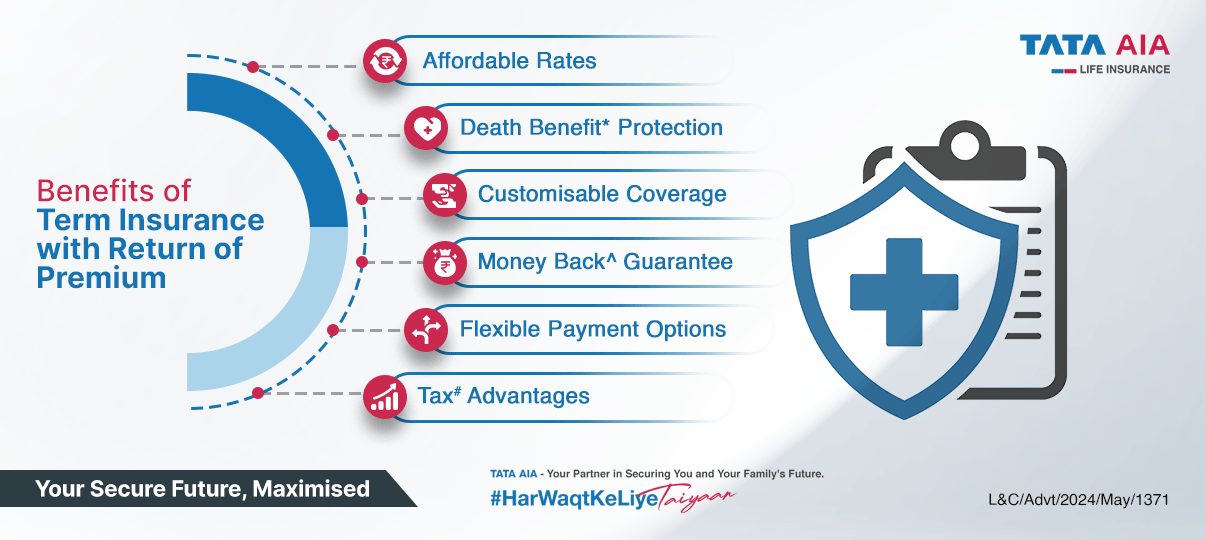
The following are the key benefits of term insurance with a return of premiums:
Tata AIA Sampoorna Raksha Promise - Non-Linked, Non-Participating, pure risk, Individual Life Insurance Product (UIN:110N176V13)
1As per the duly approved product design and terms & conditions of the product, Illustrated premium is the monthly premium for a 20 yr. old female, Standard Life, Non-Smoker for ₹1 Cr. Sum Assured with Policy Term of 40 yrs. (Regular Pay) under Life Promise Plus Option of Tata AIA Sampoorna Raksha Promise with first year premium discount of 10% for digital purchase and 8.5% for salaried person. Please refer Benefit Illustration for more details.
Premium is subject to applicable taxes, cesses & levies which will be entirely borne/ paid by the Policyholder, in addition to the payment of such Premium. Tata AIA Life shall have the right to claim, deduct, adjust, recover the amount of any applicable tax or imposition, levied by any statutory or administrative body, from the benefits payable under the Policy. Kindly refer the sales illustration for the exact premium.
2Under Life Promise Plus Option, an amount equal to the 100% of the Total Premiums Paid (excluding loading for modal premiums) shall be payable at the end of the Policy Term, provided the life assured survives till maturity and the policy is not terminated earlier.
3Applicable to only non-early claims with more than 3 years of policy duration, non-investigation cases, up to Sum Assured of ₹50 Lakh. Applicable for branch walk in. Time limit to submit claim to Tata AIA Life Insurance is 2 pm on working days. Subject to submission of complete documents. Not applicable for ULIP policies and open title claims.
4Tax benefits of up to ₹46,800 u/s 80C is calculated at highest tax slab rate of 31.20% (including cess excluding surcharge) on life insurance premium paid of ₹1,50,000. Tax benefits under the policy are subject to conditions laid under Section 80C, 80D,10(10D), 115BAC and other applicable provisions of the Income Tax Act,1961. Good and Service tax and Cess, if any will be charged extra as per prevailing rates. The Tax Free income is subject to conditions specified under section 10(10D) and other applicable provisions of the Income Tax Act,1961. Tax laws are subject to amendments made thereto from time to time. Please consult your tax advisor for details, before acting on above.
5Guaranteed/Guarantee: Guaranteed Returns/Payouts depend on Plan Option, Policy Term, Premium Payment Term and Age at entry
6Applicable for specific plan options. Please refer brochure for additional details.
7Rider is not mandatory and is available for a nominal extra cost. For more details on benefits, premiums, and exclusions under the Rider, please contact Tata AIA Life's Insurance Advisor/ branch.
898,01,699 families protected till 18th May 2026.
9Individual Death Claim Settlement Ratio is 99.45% for FY 2025-26 as per latest annual audited figure.
10Income Tax benefits would be available as per the prevailing income tax laws, subject to fulfillment of conditions stipulated therein. Income Tax laws are subject to change from time to time. Tata AIA Life Insurance Company Ltd. does not assume responsibility on tax implication mentioned anywhere in this document. Please consult your own tax consultant to know the tax benefits available to you.
Insurance cover is available under this product.
This product is underwritten by Tata AIA Life Insurance Company Ltd.
The plan is not a guaranteed issuance plan, and it will be subject to company’s underwriting and acceptance.
For more details on risk factors, terms and conditions please read sales brochure carefully before concluding a sale.
L&C/Advt/2026/Aug/4752
Popular Searches
Last updated on 15 Oct 2026














 Written by


 Reviewed by










 10 mins read