














Call us
Call us
 FOR EXISTING POLICY
Have query on premium, payout or any servicing need?
Call us:
 FOR NEW POLICY
Want to buy a new policy online?
FOR NEW POLICY
Want to buy a new policy online?
FOR NEW POLICY (NRIs)
Note: Consent is provided to Tata AIA Life Insurance Company Limited to contact you by calling/giving missed call to the above numbers.
Thank you for sharing your details. To receive a call from Tata AIA Financial Advisor.
reCAPTCHA is not working.
No relevant search results found.
Popular searches
Continue from where you left of

Share


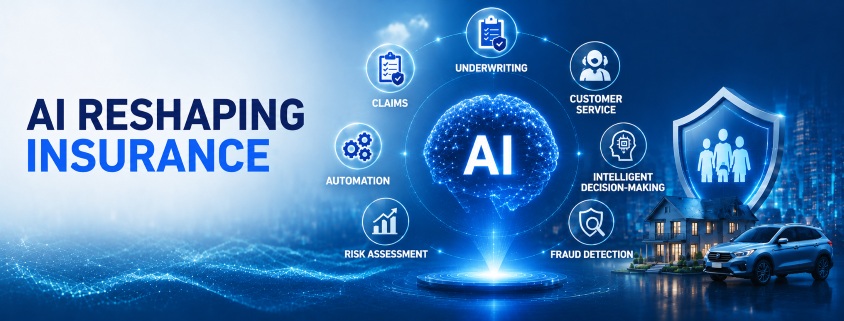
Artificial Intelligence (AI) is transforming the insurance industry by changing how insurers assess risk, engage customers, process claims and manage operations. What began as simple automation — software performing repetitive tasks such as data entry — has evolved into sophisticated predictive models, real-time analytics and intelligent decision-support systems. In plain terms, insurers are moving from machines that merely follow instructions to machines that learn from data and help humans make better decisions. Today, AI is a strategic capability that directly influences underwriting quality, claims efficiency, regulatory compliance, customer experience and profitability.
One of the most significant applications of AI is in underwriting — the process by which an insurer evaluates how risky a customer is and decides the terms and price of cover. Traditionally, underwriting relied on manual analysis of limited datasets, resulting in lengthy processing times and inconsistent decisions. AI-powered machine learning models — algorithms that improve automatically as they are exposed to more data — can now analyse enormous volumes of both structured data (organised information such as claims records and policy details) and unstructured data (free-form information such as documents, images and behavioural patterns) in a fraction of the time. The result is more accurate risk segmentation, sharper pricing and faster policy issuance.
Claims management is another area reaping significant benefits. Intelligent automation and predictive analytics — statistical techniques that use historical data to forecast likely outcomes — help insurers assess claim severity, prioritise cases and accelerate settlements. AI systems can read images, documents and claim histories to support faster decision-making while improving accuracy and flagging potentially fraudulent patterns. For the policyholder, this translates into quicker claim resolution, greater transparency and a far less stressful experience at the very moment support is needed most.
Customer engagement is increasingly shaped by AI-powered tools such as virtual assistants and chatbots (software that converses with customers in natural language), recommendation engines (systems that suggest suitable products based on individual profiles) and behavioural analytics platforms. These technologies allow insurers to personalise every stage of the customer journey — from purchase and onboarding to renewals and claims support — with relevant recommendations, proactive communication and tailored products rather than one-size-fits-all offerings.
With greater reliance on AI comes the need for effective governance — the framework of checks that ensures automated systems remain accurate, fair and accountable. Robust governance requires model validation (independently testing whether an AI model actually works as intended), ongoing performance monitoring, transparent decision frameworks and clear accountability for outcomes. Done well, governance ensures AI strengthens organisational resilience rather than introducing new vulnerabilities such as hidden bias in pricing or claims decisions.
The future of insurance depends equally on developing AI-ready professionals who combine industry expertise with analytical and digital capabilities. Underwriters, claims specialists, risk managers and compliance professionals must be equipped to interpret AI-generated insights, challenge model outputs where they look wrong, and integrate data-driven intelligence into business decisions. AI, in other words, is not replacing insurance judgement — it is raising the standard of evidence on which that judgement rests. For customers and investors alike, the insurers that master this blend of technology and human oversight are likely to deliver better products, fairer prices and stronger long-term performance.
Reference: AI in Insurance: From Operational Efficiency to Strategic Risk Intelligence, RMAI (December 18, 2025) — rmaindia.org
Need assistance in choosing the right insurance plan?
Get 1 Crore Life Cover + 7% Digital Discount on Year 1 Premium

Our experts are happy to help you!
This blog is for information and illustrative purposes only and does not purport to any financial or investment services and do not offer or form part of any offer or recommendation. The information is not and should not be regarded as investment advice or as a recommendation regarding any particular security or course of action.
Every effort is made to ensure that all information contained in this blog is accurate at the date of publication, however, the Tata AIA Life shall not have any liability for any damages of any kind (including but not limited to errors and omissions) whatsoever relating to this material.

 10 mins read