











Call us
Call us
 FOR EXISTING POLICY
Have query on premium, payout or any servicing need?
Call us:
 FOR NEW POLICY
Want to buy a new policy online?
FOR NEW POLICY
Want to buy a new policy online?
FOR NEW POLICY (NRIs)
Note: Consent is provided to Tata AIA Life Insurance Company Limited to contact you by calling/giving missed call to the above numbers.
Thank you for sharing your details. To receive a call from Tata AIA Financial Advisor.
reCAPTCHA is not working.
No relevant search results found.
Popular searches
Continue from where you left of

Share


Need assistance in choosing the right insurance plan?
Get 1 Crore Life Cover + 7% Digital Discount on Year 1 Premium

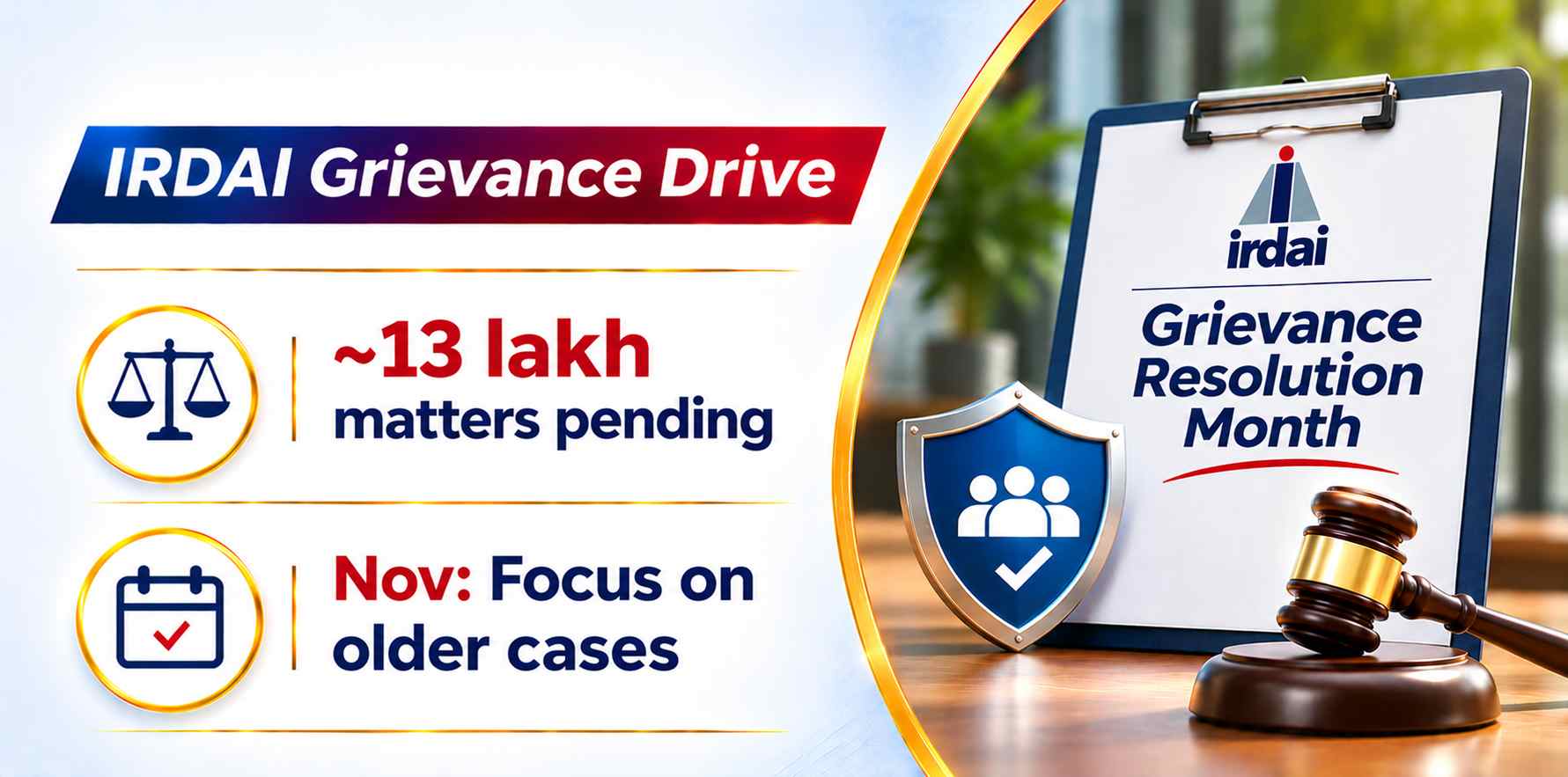
On 29 October 2026, the Insurance Regulatory and Development Authority of India (IRDAI) announced that November would be observed as Grievance Resolution Month across life and general insurance. The drive was formally launched in Hyderabad on 31 October. Its aim is to speed up fair and meaningful resolution of pending policyholder grievances, particularly disputes that have dragged on for more than a year. The initiative rests on IRDAI’s statutory mandate: Section 14 of the IRDAI Act lists protecting policyholders’ interests among the regulator’s core functions.
| Pending insurance disputes (as of 31 March 2026) | Number |
|---|---|
Cases before Consumer Commissions and courts |
About 2.21 lakh |
Share of these pending for more than a year |
72.49% |
Cases before Motor Accidents Claims Tribunals (MACT) |
About 11 lakh |
Total pending matters |
About 13 lakh |
Source: IRDAI data, as reported in October–November 2026.
Almost three in every four cases in courts and consumer forums are more than a year old. The much larger MACT backlog relates mainly to motor third-party claims, so it falls largely on general insurers.
IRDAI has set out six expectations for the month. Insurers should review all pending matters and prioritise the oldest. They should settle litigation amicably wherever that is legally and factually sustainable. They should comply promptly with Insurance Ombudsman awards, and speed up cases pending before other forums. They should strengthen how they manage litigation so that disputes do not drag on unnecessarily. Finally, they should identify the recurring causes of complaints and fix them through corrective and preventive action.
IRDAI, the Life and General Insurance Councils, and State-wise lead insurers will also run outreach programmes nationwide, both online and through branches. These will focus on Tier-II and Tier-III cities, where awareness of grievance redressal and access to it are weakest.
Most complaints never reach a court. They are registered with insurers through Bima Bharosa, IRDAI’s grievance registration and monitoring portal. Government data cited in Parliament show that insurers received 2.97 lakh complaints through the portal in FY26 and resolved 2.87 lakh. Life insurers received 1.19 lakh complaints, resolved 1.18 lakh, and ended the year with just 598 pending.
| Life insurance grievances | FY24 | FY25 | FY26 |
|---|---|---|---|
Total registered |
1,20,726 |
1,20,429 |
About 1.19 lakh |
Unfair business practices (incl. misselling) |
23,335 |
26,667 |
|
Unfair business practices as a share of total |
19.33% |
22.14% |
|
Pending at year-end |
— |
554 |
598 |
Source: IRDAI Annual Report 2024-25; Ministry of Finance reply in Parliament citing IRDAI data (FY26).
Overall complaint volumes against life insurers have been flat, but what people complain about has changed. Grievances classified as unfair business practices, which include mis-selling, rose about 14% in FY25. Their share of all life insurance complaints climbed from 19.33% to 22.14%. Outcomes in these cases were mixed. Of the unfair-practice grievances resolved in FY25, more than 15,000 were decided against policyholders, while about 11,400 were resolved fully or partly in their favour. IRDAI has asked insurers to assess product suitability, put in place controls specific to each distribution channel, and carry out regular root-cause analysis of mis-selling complaints.
Claims account for a smaller share of disputes than is often assumed. In FY25, life insurers received 33,280 claim-related complaints against 26.68 lakh claims reported, or about 1.2%. Normalised for size, life insurance recorded 15.72 grievances per lakh policies and lives, against 5.29 for general and health insurance.
Policyholders who are not satisfied with an insurer’s response can approach the Insurance Ombudsman. In FY25, the Ombudsman offices handled 17,237 life insurance complaints: 1,895 carried over from the previous year and 15,342 newly received. Ten insurers accounted for 68.6% of these.
Two points stand out. First, the problem is not how many complaints insurers resolve. Almost every complaint registered on Bima Bharosa is closed within the year. The damage comes from the minority that escalate into litigation and then sit there for years. That is the backlog Grievance Resolution Month is designed to clear.
Second, life insurance complaints are increasingly about how products are sold rather than whether claims are paid. This links the month directly to IRDAI’s distribution reform proposals (see Insurance Industry News), which aim to tighten suitability requirements and allow commissions to be clawed back where mis-selling is established. With insurance penetration flat at 3.7% in FY25, the regulator’s view is that trust and growth are closely linked.
Step 1: Complain to the insurer’s Grievance Redressal Officer in writing and keep the dated acknowledgement.
Step 2: If unresolved, escalate through IRDAI’s Bima Bharosa portal (bimabharosa.irdai.gov.in), the IRDAI Grievance Call Centre (155255 / 1800 4254 732), or by email to complaints@irdai.gov.in.
Step 3: Approach the Insurance Ombudsman within one year of the insurer’s final reply, or of one month passing without a reply. There are 17 Ombudsman offices across India, with awards of up to ₹50 lakh.
Step 4: Consumer commissions and courts remain available. A complaint already before a court or consumer forum cannot also be taken to the Ombudsman.
FIN-EDIT VIEW
Grievance Resolution Month runs for thirty days, but the message behind it is permanent. IRDAI is moving from measuring how quickly complaints are closed to asking why they arise in the first place, especially at the point of sale. Insurers that treat the month as a backlog-clearing exercise will meet the deadline. Insurers that treat it as a root-cause review will be better prepared for the distribution reforms that follow.
Special Section: IRDAI announcement on Grievance Resolution Month (29 Oct 2026), as reported by GKToday, Elets BFSI, Zenith Financial Management and Whalesbook (Oct–Nov 2026); IRDAI Annual Report 2024-25, as reported by Business Standard, Outlook Money and Insurance Business (Dec 2025–Jan 2026); Cafemutual, FY26 Bima Bharosa data (Aug 2026) and Ombudsman FY25 data (Feb 2026); IRDAI Grievance Cell (PPGR) FAQ.
Our experts are happy to help you!
This blog is for information and illustrative purposes only and does not purport to any financial or investment services and does not offer or form part of any offer or recommendation. The information is not and should not be regarded as investment advice or as a recommendation regarding any particular security or course of action.
Every effort is made to ensure that all information contained in this blog is accurate at the date of publication, however, the Tata AIA Life shall not have any liability for any damages of any kind (including but not limited to errors and omissions) whatsoever relating to this material.

 10 mins read