











Call us
Call us
 FOR EXISTING POLICY
Have query on premium, payout or any servicing need?
Call us:
 FOR NEW POLICY
Want to buy a new policy online?
FOR NEW POLICY
Want to buy a new policy online?
FOR NEW POLICY (NRIs)
Note: Consent is provided to Tata AIA Life Insurance Company Limited to contact you by calling/giving missed call to the above numbers.
Thank you for sharing your details. To receive a call from Tata AIA Financial Advisor.
reCAPTCHA is not working.
No relevant search results found.
Popular searches
Continue from where you left of

Share


Need assistance in choosing the right insurance plan?
Get 1 Crore Life Cover + 7% Digital Discount on Year 1 Premium

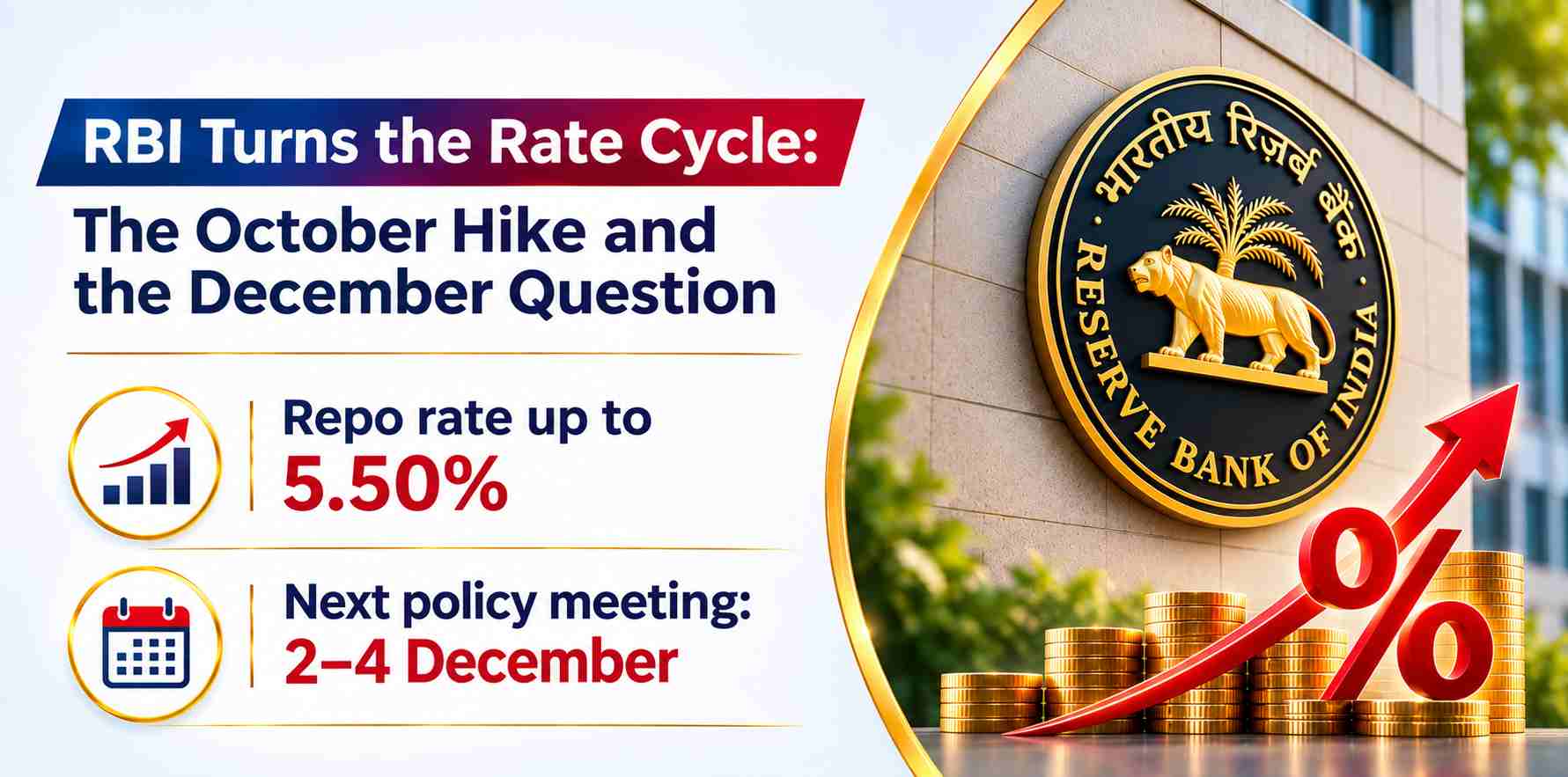
On 7 October 2026, the Reserve Bank of India’s Monetary Policy Committee (MPC) voted unanimously to raise the repo rate, the rate at which the RBI lends to banks, by 25 basis points (0.25 percentage points) to 5.50%. It also changed its policy stance from “neutral” to “calibrated tightening”. The MPC used this to signal that rate cuts are off the table in the near term. The rate is now back where it stood at Diwali 2025, after a cut to 5.25% in December 2025.
The pressure came mostly from outside the RBI’s control. The re-escalation of the West Asia conflict pushed up energy prices sharply. The RBI estimated that the Indian crude basket averaged US$116.1 a barrel in September, up from US$82 in July. India imports roughly 85% of its crude oil, so costlier fuel quickly raises transport and input costs across the economy.
A deficient monsoon, about 13% below normal, added to food prices. A weaker rupee made every imported barrel more expensive in rupee terms. The result was a steady climb in Consumer Price Inflation (CPI): 4.8% in August, the third consecutive month above the RBI’s 4% target, and 5.54% in September, with food inflation at 7.74%.
Just as worrying for the MPC was the rise in inflation expectations. In the RBI’s September household survey, the median expectation for inflation three months ahead jumped to 9.9%. Central banks watch this number closely, because expectations of higher prices can become self-fulfilling through wage demands and pricing decisions.
| Indicator | RBI projection (Oct 2026) | Previous (Aug 2026) |
|---|---|---|
FY27 CPI inflation |
5.2% |
5.0% |
CPI, Oct–Dec 2026 quarter |
Peak of around 6% |
— |
FY27 real GDP growth |
7.1% |
— |
Policy repo rate |
5.50% |
5.25% |
With growth still strong at a projected 7.1%, the RBI judged that the economy could absorb a hike, and that acting early was the cheaper option than letting inflation become entrenched.
The minutes of the October meeting confirmed a hawkish committee. Members cited crude prices, food inflation, elevated precious-metal prices and rupee depreciation as continuing risks. Economists at Nomura and SBI Research had forecast hikes at both the October and December meetings, which would take the repo rate to 5.75%. Treasury teams should treat 2–4 December as a genuine hike-or-pause decision.
The data points that will decide it are the October CPI print, the path of crude oil after the latest round of West Asia tensions, the rupee, and the second-quarter GDP estimate due at the end of November.
For borrowers: home and other loans linked to the repo rate will reset upwards at their next reset date, raising EMIs or extending tenures.
For savers: deposit rates typically follow policy rates with a lag, so fixed-deposit rates may firm up over the coming months.
For bond markets: higher rates mean lower prices for existing bonds, and longer-dated bonds are the most affected. New investments, by contrast, lock in higher yields.
For long-term savings: a higher-rate environment generally improves the yields available on fresh fixed-income investments. That supports the economics of long-duration savings products. It also brings mark-to-market pressure on existing bond holdings across the financial system.
FIN-EDIT VIEW
This is a supply-shock tightening, not a response to an overheating economy. The RBI is buying insurance against inflation becoming entrenched. That makes December more about how far expectations have stabilised than about the headline CPI number alone.
lndia News: RBI MPC statement and minutes (7 and 21 Oct 2026) as reported by Business Today, ETV Bharat, The Week, The Daily Pioneer, Rio Times and The Morning Voice (Oct 2026).
Our experts are happy to help you!
This blog is for information and illustrative purposes only and does not purport to any financial or investment services and does not offer or form part of any offer or recommendation. The information is not and should not be regarded as investment advice or as a recommendation regarding any particular security or course of action.
Every effort is made to ensure that all information contained in this blog is accurate at the date of publication, however, the Tata AIA Life shall not have any liability for any damages of any kind (including but not limited to errors and omissions) whatsoever relating to this material.

 10 mins read