











Call us
Call us
 FOR EXISTING POLICY
Have query on premium, payout or any servicing need?
Call us:
 FOR NEW POLICY
Want to buy a new policy online?
FOR NEW POLICY
Want to buy a new policy online?
FOR NEW POLICY (NRIs)
Note: Consent is provided to Tata AIA Life Insurance Company Limited to contact you by calling/giving missed call to the above numbers.
Thank you for sharing your details. To receive a call from Tata AIA Financial Advisor.
reCAPTCHA is not working.
No relevant search results found.
Popular searches
Continue from where you left of

Share


Need assistance in choosing the right insurance plan?
Get 1 Crore Life Cover + 7% Digital Discount on Year 1 Premium

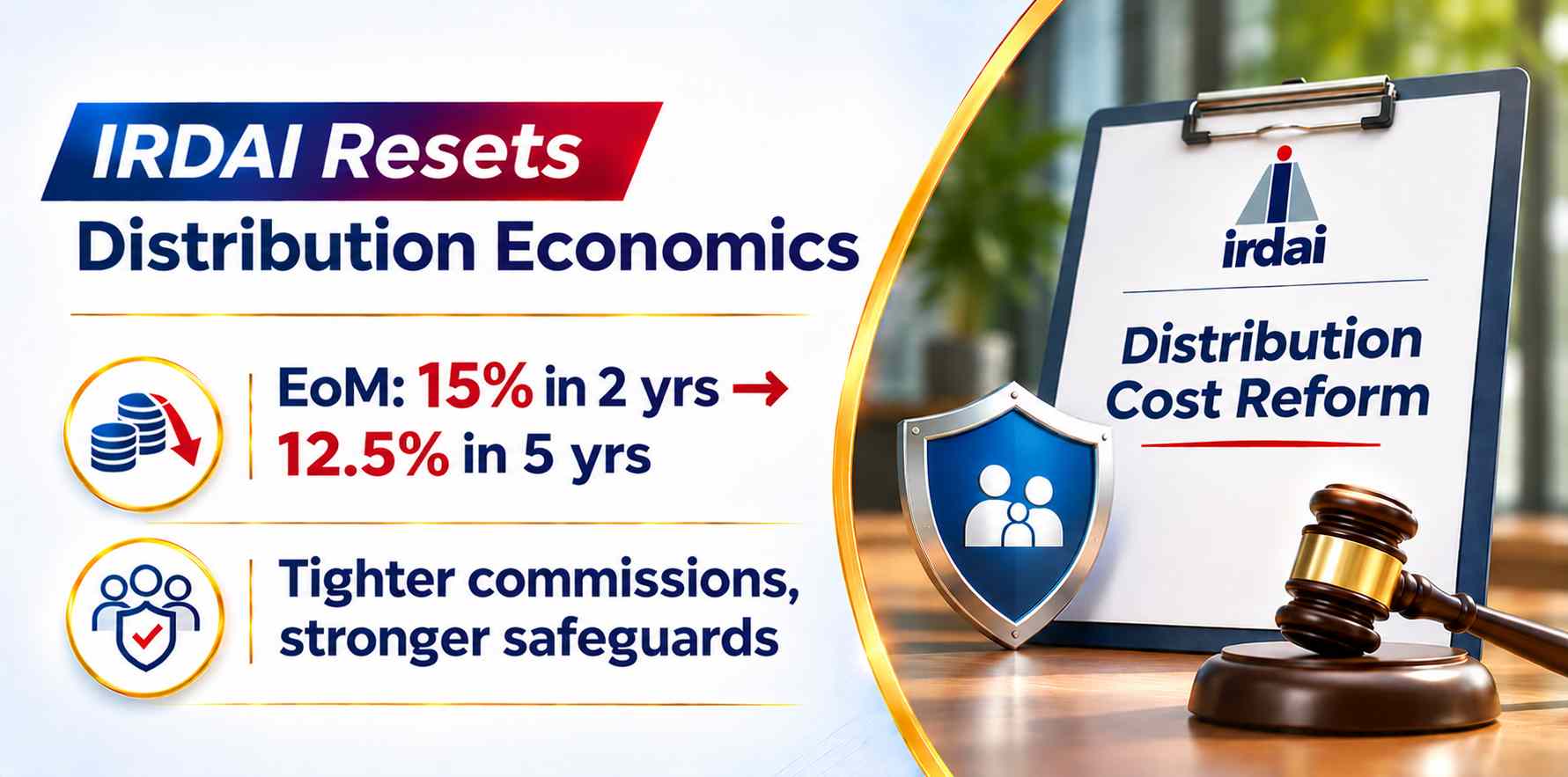
On 23 September 2026, the Insurance Regulatory and Development Authority of India (IRDAI) released a two-part consultation paper titled “Recalibrating Economics of Insurance Distribution”. It is the regulator’s most significant intervention on distribution costs since April 2023. At that point, IRDAI removed product-specific commission caps and allowed insurers to set commissions through board-approved policies, within an overall expense ceiling.
Lower expense limits: The Expense of Management (EoM) limit caps the total an insurer can spend on acquiring and servicing business, including commissions. For life insurers, the paper proposes cutting it to 15% of Gross Direct Premium Income (GDPI) within two years, and to 12.5% within five years.
Product- and channel-specific commission caps: The paper proposes separate ceilings by product and by distribution channel. Individual agents would get higher caps than corporate distributors such as banks and brokers, to reflect the greater effort involved in individual sales. The proposed caps are below prevailing industry rates in several segments. Analysts estimate the cuts could amount to between one-third and one-half of current commissions across new life, health and motor business.
Safeguards against mis-selling: Distributors would need to document customer needs and suitability. Commissions could be clawed back where mis-selling is established. Compulsory bundling of insurance with other financial products, such as loans, would be restricted.
Digital public infrastructure: The paper envisages greater use of Bima Sugam and the Public Insurance Registry to support comparison, portability, purchase and servicing of policies.
Part 2 of the paper sets out IRDAI’s evidence. The regulator found that private life insurers paid, on average, 31% of their commissions to related-party distributors, and as much as 95% in some cases. Commission on group credit-life business climbed from 5% to 28%, an effective payout of about 45%. IRDAI’s conclusion is that remuneration is increasingly set by competition for distribution relationships rather than by the effort of selling.
IRDAI Chairman Ajay Seth has defended the proposals as an orderly transition to lower costs for policyholders. He has noted cases where distributor remuneration grew much faster than premiums after the earlier caps were removed.
Insurers met the Chairman informally in Mumbai shortly after the paper was released. They asked for a glide path on commission cuts and for EoM limits that differ by business model. Bank-led distributors and those selling high-volume, low-ticket policies flagged particular concerns. They argued that the bundling restrictions could make policies requiring heavy last-mile servicing commercially difficult. Agent bodies have also voiced concern about the impact on their earnings.
The consultation closed in late October with more than 650 submissions from insurers, banks, agents and brokers. Chairman Seth has said the regulator is in a listening phase and will proceed only after building consensus. Draft regulations will again be placed for public consultation. No final timeline has been notified, and IRDAI has not issued any mandate on the related four-layer motor insurance structure that is also under discussion.
FIN-EDIT VIEW
The direction of travel is clear: lower distribution costs, more transparency and greater accountability for suitability. What remains open is how fast the change comes and whether limits will differ by channel. The second consultation on draft regulations will be the moment to watch.
Insurance Industry News: IRDAI consultation paper “Recalibrating Economics of Insurance Distribution” (23 Sep 2026), as reported by Business Standard (28 Sep 2026), Indian Masterminds (Oct 2026), The Federal (Nov 2026) and Whalesbook (Nov 2026).
Our experts are happy to help you!
This blog is for information and illustrative purposes only and does not purport to any financial or investment services and does not offer or form part of any offer or recommendation. The information is not and should not be regarded as investment advice or as a recommendation regarding any particular security or course of action.
Every effort is made to ensure that all information contained in this blog is accurate at the date of publication, however, the Tata AIA Life shall not have any liability for any damages of any kind (including but not limited to errors and omissions) whatsoever relating to this material.

 10 mins read