











Call us
Call us
 FOR EXISTING POLICY
Have query on premium, payout or any servicing need?
Call us:
 FOR NEW POLICY
Want to buy a new policy online?
FOR NEW POLICY
Want to buy a new policy online?
FOR NEW POLICY (NRIs)
Note: Consent is provided to Tata AIA Life Insurance Company Limited to contact you by calling/giving missed call to the above numbers.
Thank you for sharing your details. To receive a call from Tata AIA Financial Advisor.
reCAPTCHA is not working.
No relevant search results found.
Popular searches
Continue from where you left of

Share


Need assistance in choosing the right insurance plan?
Get 1 Crore Life Cover + 7% Digital Discount on Year 1 Premium

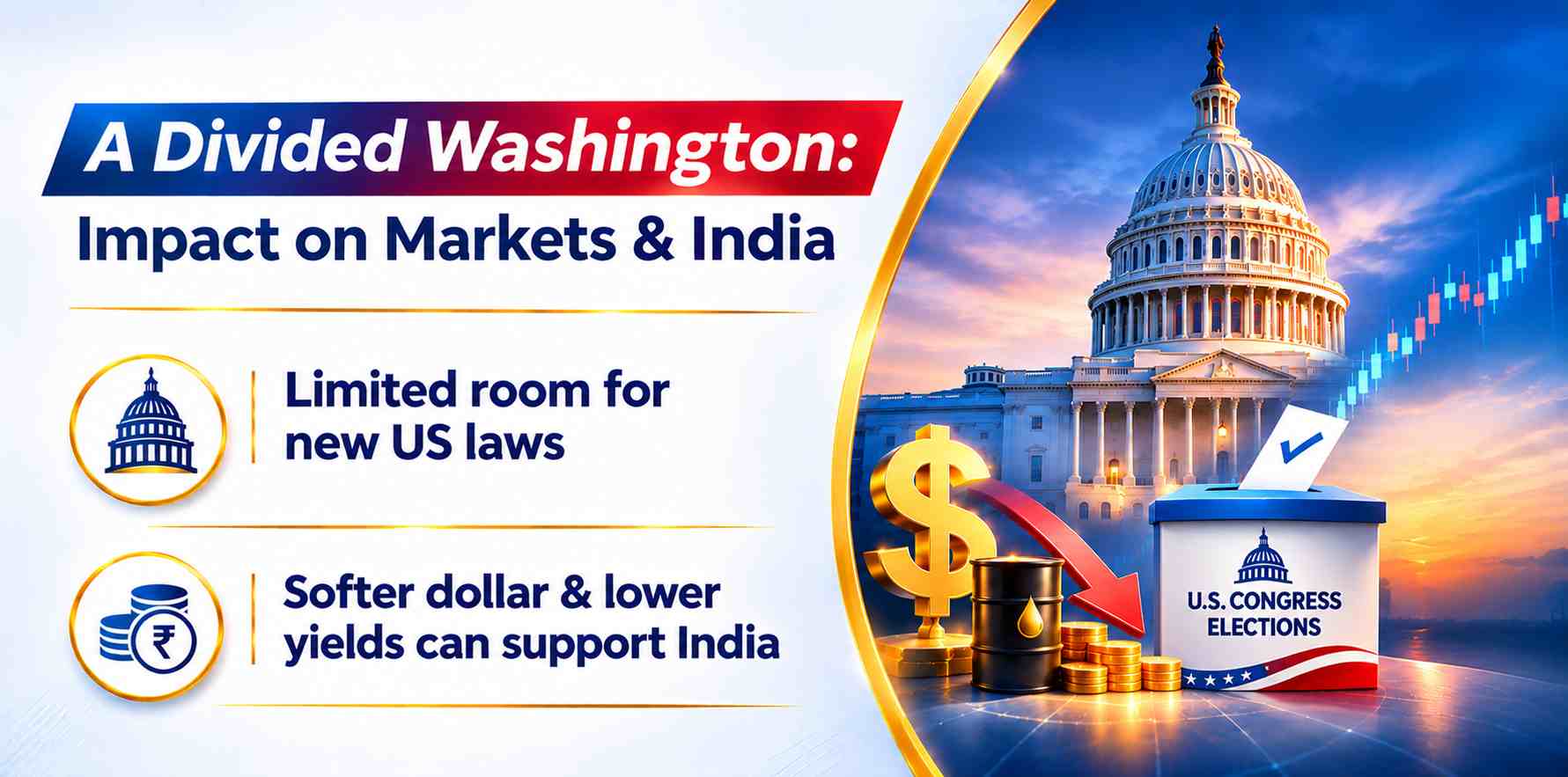
On 3 November 2026, American voters gave the Democratic Party control of both chambers of Congress. NBC News and CBS News projected Democratic majorities in the House of Representatives and the Senate overnight, and the Associated Press called the Senate in the early hours of 4 November. Republicans had gone into Election Day with narrow majorities of 53–47 in the Senate and 219–214 in the House. Flipping both chambers in a single midterm is rare. It has happened only a handful of times since the Second World War.
Voter discontent over the cost of living and the conflict in West Asia featured prominently in coverage of the results. President Trump congratulated the Democrats while saying he did not see the outcome as a rejection of his leadership.
For the next two years, the White House and Congress will be controlled by different parties, an arrangement usually called divided government. Any new law on taxation, spending or regulation now needs agreement across party lines. In practice, that sharply narrows the scope for major new legislation.
Much of what has moved markets this year sits outside Congress, however. Ahead of the vote, Morgan Stanley Research pointed out that the executive branch keeps primary control over tariffs, foreign policy, regulation and immigration. These are the levers that have shaped asset prices through 2026. The administration’s trade policy, including its tariff posture towards India, does not change simply because of the election.
Markets responded quickly. US stock futures fell sharply as results came in, Treasury yields dipped, and the dollar weakened. In Asia, Japan’s Nikkei fell about 3% as AI-linked stocks came under pressure. A Democratic sweep had not been fully priced in, since the S&P 500 had already delivered double-digit gains in 2026. Several strategists argued that the bigger risk was investors overreacting to the result rather than the result itself.
History offers some perspective. CNBC analysis finds that the S&P 500 has gained an average of 13.7% in the twelve months after midterm elections, with positive returns in 91% of cases. Markets have generally responded to clarity about policy more than to which party wins.
The AI trade: There are concerns that a Democratic Congress could support restrictions on data-centre expansion. That has added pressure to an AI-led rally that was already wobbling before the vote. Capital spending by the large technology platforms has been a central driver of US earnings growth, so any slowdown would spread through global technology supply chains, including Indian IT services.
Fiscal policy: Analysts at Natixis suggested that a strong Democratic showing could reduce expectations of further fiscal stimulus. Less fiscal expansion would, other things being equal, ease pressure on long-term US borrowing costs.
The dollar and US yields: If the weaker dollar and lower Treasury yields persist, that is generally supportive for emerging markets. It narrows the interest-rate gap that has drawn capital back to the US.
The direct effect on India works mainly through capital flows. A softer dollar and lower US yields would help the rupee and could improve the case for foreign portfolio investors (FPIs) to return to Indian equities and bonds after a difficult year. That matters because the rupee’s weakness has added to imported inflation, one of the reasons the RBI raised rates in October (see India News).
On trade, nothing structural changes yet, because tariff authority stays with the executive. On technology, Indian IT exporters should watch US corporate technology budgets closely.
FIN-EDIT VIEW
The midterm result changes the legislative arithmetic in Washington more than it changes the economic weather. For Indian markets, the path of crude oil, the dollar and US interest rates will matter far more over the coming months than the composition of Congress.
All figures are drawn from public sources as of 4 November 2026 and should be refreshed at final drafting.
Global News: NBC News, CBS News, TIME and The Washington Post election live coverage (3–4 Nov 2026); Reuters, “Analysts react to US midterm election results” (4 Nov 2026); CNBC, “Midterm elections could jolt stocks…” (3 Nov 2026); Morgan Stanley Research, “Midterm Elections: More Noise Than Change?” (2026).
Our experts are happy to help you!
This blog is for information and illustrative purposes only and does not purport to any financial or investment services and does not offer or form part of any offer or recommendation. The information is not and should not be regarded as investment advice or as a recommendation regarding any particular security or course of action.
Every effort is made to ensure that all information contained in this blog is accurate at the date of publication, however, the Tata AIA Life shall not have any liability for any damages of any kind (including but not limited to errors and omissions) whatsoever relating to this material.

 10 mins read