














Call us
Call us
 FOR EXISTING POLICY
Have query on premium, payout or any servicing need?
Call us:
 FOR NEW POLICY
Want to buy a new policy online?
FOR NEW POLICY
Want to buy a new policy online?
FOR NEW POLICY (NRIs)
Note: Consent is provided to Tata AIA Life Insurance Company Limited to contact you by calling/giving missed call to the above numbers.
Thank you for sharing your details. To receive a call from Tata AIA Financial Advisor.
reCAPTCHA is not working.
No relevant search results found.
Popular searches
Continue from where you left of

Share


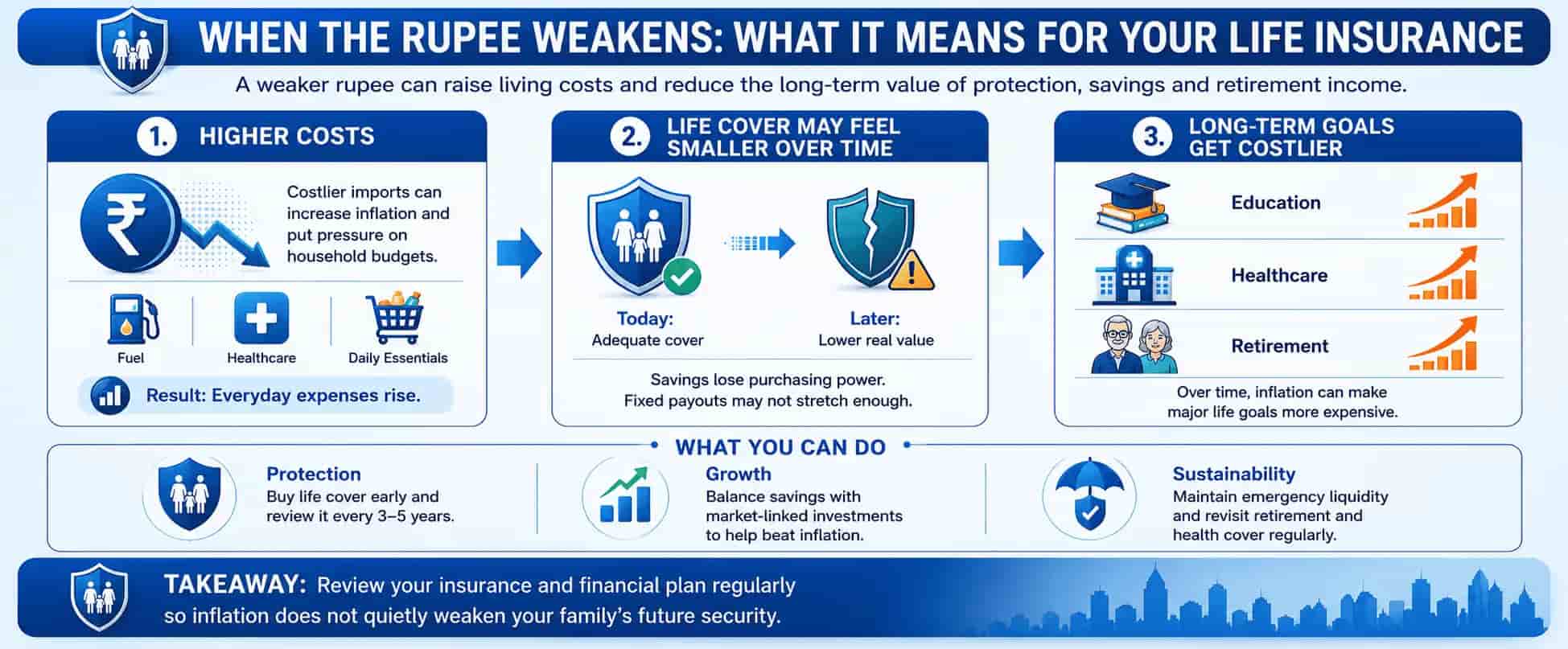
You may have heard that “the rupee is weakening against the dollar.” In simple terms, this means it takes more rupees to buy the same one US dollar than it did before — so anything India buys from abroad becomes costlier. Since India imports large amounts of crude oil, electronics and medical equipment, a weaker rupee can push up prices on these items. Over time, this filters into the prices we pay for petrol, gadgets and medical care, and even into the cost of long-term goals like your child’s education or your own retirement.
More generally, a falling rupee is a good prompt to tighten up your everyday money habits. Avoid big-ticket discretionary purchases — imported electronics, foreign holidays, foreign education fees — until the currency stabilizes, since these cost more. If you have a loan in a foreign currency or are planning one, factor in the rise in repayments. Keep a close eye on fuel and household budgets, since imported crude oil feeds directly into prices at the pump and indirectly into almost everything else. And resist reacting to short-term currency swings by pulling money out of long-term investments — the rupee moves in cycles, and decisions made in panic usually cost more than the weakness itself.
If you have a life insurance policy, here’s why this matters. Your “sum assured” is the fixed amount your policy promises to pay — either to your family if something happens to you, or to you at maturity. The trouble is that 10,000 rupees today won’t buy as much 15 years from now, because prices keep rising (this is called inflation). So, a sum assured that feels generous today could feel quite small by the time it’s actually needed. The same logic applies to your savings and any fixed payouts you may be counting on after retirement — their real value can quietly shrink.
Some practical steps:
Buy life cover while you’re young, since it’s cheaper and you lock in protection early.
Review your cover every 3-5 years to check it still matches your family’s needs.
Split your savings between safe options and market-linked ones, so your money has a chance to outpace inflation.
Keep some funds easily accessible for emergencies.
And don’t forget your health cover — medical costs tend to rise faster than everyday prices, so this is worth checking too.
The bigger picture: this may feel distant, but it shapes everyday money decisions. A periodic check-up of your insurance, savings and retirement plans helps protect what you’ve built.
Need assistance in choosing the right insurance plan?
Get 1 Crore Life Cover + 7% Digital Discount on Year 1 Premium

Our experts are happy to help you!
This blog is for information and illustrative purposes only and does not purport to any financial or investment services, and do not offer or form part of any offer or recommendation. The information is not and should not be regarded as investment advice or as a recommendation regarding any particular security or course of action.
Every effort is made to ensure that all information contained in this blog is accurate at the date of publication; however, the Tata AIA Life shall not have any liability for any damages of any kind (including but not limited to errors and omissions) whatsoever relating to this material.

 10 mins read