
















Call us
Call us
 FOR EXISTING POLICY
Have query on premium, payout or any servicing need?
Call us:
 FOR NEW POLICY
Want to buy a new policy online?
FOR NEW POLICY
Want to buy a new policy online?
FOR NEW POLICY (NRIs)
Note: Consent is provided to Tata AIA Life Insurance Company Limited to contact you by calling/giving missed call to the above numbers.
Thank you for sharing your details. To receive a call from Tata AIA Financial Advisor.
reCAPTCHA is not working.
No relevant search results found.
Popular searches
Continue from where you left of
ULIP taxation refers to the tax2 treatment of Unit-Linked Insurance Plan (ULIP) investments under the Income Tax Act, 2025, during the policy term and... Read more at maturity. Premiums qualify for tax2 deductions under Section 123, Schedule XV (erstwhile section 80C) (up to the overall limit of ₹1,50,000, subject to prescribed conditions), while maturity proceeds may be tax -free under Schedule II(2) (erstwhile Section 10(10D). However, policies exceeding the prescribed premium limit or surrendered early may be taxed as capital gains, as per applicable provisions. Read Less
Investment Calculator
Here’s your customised plan
Get Maturity Benefit
As per assumed rate of return
₹34.57 Lakh
As per actual past performance
₹70.50 Lakh
Total premium: ₹11.99 Lakh
Additional Benefits
Life Cover (including Terminal Illness Cover)
Accidental Death Cover
Accidental Total & Permanent Disability
Discount
Applicable if the policy is purchased digitally.
This discount is auto-applied and can't be removed
Tata AIA Premier SIP is a combination of the Tata AIA Smart SIP - Non-participating, Unit-linked, Individual Life Insurance Savings Plan (UIN: 110L174V01) and
Tata AIA Health Buddy - Non-participating, Non-Linked, Individual Health Product (UIN:110N183V01). Both Tata AIA Smart SIP and Tata AIA Health Buddy are also available for sale individually. Product option: Future Secure.

Your premium calculation is in progress
Kindly enter the OTP sent to
Please enter valid OTP
01:60
Didn't receive OTP?
Success
Your details have been successfully submitted. A representative from Tata AIA Life Insurance will call you soon.
Failure
Your details could not be saved.
Please try again.
The tax5 treatment of a ULIP depends on different stages of the policy lifecycle, including premium payments, policy continuation, maturity, surrender, and death claims. The applicable provisions are governed by the Income Tax Act 2025 and have changed over time through amendments introduced in the Finance Act.
During the policy term, eligible premiums may qualify for deductions under Section 123 (Schedule XV), subject to the overall deduction limit and prescribed eligibility conditions. At maturity, the proceeds may remain exempt under Schedule II(2). If the policy satisfies the applicable premium and sum assured requirements. However, certain high-premium policies issued on or after 1 February 2021 may not qualify for this exemption and are taxed as capital gains under the applicable provisions.
Understanding these ULIP taxation rules before investing can help you make informed financial decisions while planning your long-term investment strategy.
A unit-linked insurance plan is a type of life insurance product that comes with a market-based investment option. Under this plan, a part of the premium goes towards securing life insurance protection, while the remaining premium is invested in equity, debt, or balanced funds. This structure allows wealth creation alongside financial protection within a single plan.
The following are the types of taxes and deductions for ULIP plans:
The taxation of maturity or withdrawal proceeds depends on whether the policy qualifies for exemption under Schedule II(2).
Maturity proceeds may remain tax2-free if the policy satisfies the prescribed conditions.
Policies issued on or after 1 February 2021 with aggregate annual premiums exceeding ₹2.5 lakh do not qualify for exemption and the gains are taxed under the head "Capital Gains" as per applicable provisions.
Early surrender or withdrawal before meeting applicable conditions may also change the tax treatment.
The applicable tax2 provisions differ depending on when the policy was issued.
Premiums paid towards eligible ULIPs may qualify for deductions under Section 123 (Schedule XV).
To claim the deduction:
Total eligible investments under Section 123 are subject to the overall limit of ₹1.5 lakh in a financial year.
Premium limits prescribed under the Income Tax2 Act, 2025, should be satisfied.
The policy should continue to meet applicable conditions throughout the required period.
One of the important features of taxation on ULIP plans is the treatment of death benefits.
Death benefits paid to the nominee remain exempt under Schedule II(2).
Exemption generally applies irrespective of the premium amount applicable to the policy.
This helps ensure financial protection for beneficiaries without an additional tax2 burden.
Whether maturity proceeds remain exempt depends on policy eligibility.
Eligible policies continue to enjoy exemption under Schedule II(2).
Non-qualifying high-premium policies issued after 1 February 2021 are taxed as capital gains.
Investors should review premium limits carefully before investing to preserve available tax2 exemptions.
The taxation framework for ULIPs changed significantly after the Finance Act, 2021. However, before the announcements reinforced in Budget 2025, qualifying ULIPs generally remained eligible for tax2 provisions available under Sections 80C and 10(10D) of the Income Tax Act, 2025, subject to the prescribed conditions. The applicable tax treatment depended on the policy issue date, annual premium amount, and compliance with the relevant eligibility requirements.
Policies that met the prescribed conditions continued to receive the available tax2 benefits.
Premiums qualified for deductions under Section 80C, subject to the overall limit of ₹1.5 lakh in a financial year.
Maturity proceeds remained exempt under Section 10(10D), provided the applicable conditions regarding the premium and sum assured were satisfied.
Death benefits continued to remain tax-free under Section 10(10D).
The Finance Act, 2021 introduced a separate taxation framework for certain high-premium ULIPs.
ULIPs issued on or after 1 February 2021 with an aggregate annual premium exceeding ₹2.5 lakh became ineligible for exemption under Section 10(10D).
The gains arising from such policies became taxable under the head "Capital Gains" as per the applicable provisions of the Income Tax Act, 1961.
These amendments aligned the taxation of high-premium ULIPs more closely with equity-oriented investment products.
Before Budget 2025, the taxation framework broadly operated as follows:
Eligible ULIPs continued to enjoy deductions under Section 80C and tax2-exempt maturity benefits under Section 10(10D), subject to the prescribed conditions.
High-premium policies continued to follow the capital gains taxation framework introduced through the Finance Act, 2021.
Investors needed to monitor premium limits and policy eligibility carefully to determine the applicable tax2 treatment.
ULIPs offer several tax2 advantages under the Income Tax Act 2025, making them a tax-efficient option for long-term financial planning when the prescribed conditions are fulfilled. Besides combining life insurance with market-linked investments, they also provide tax benefits at different stages of the policy, including premium payments, maturity, and death claims.
Premiums paid towards eligible ULIP policies may qualify for deductions under Section 123 (Schedule XV) of the Income Tax Act, 2025.
You can claim deductions up to the overall limit of ₹1.5 lakh in a financial year.
The deduction is available only if the prescribed premium-to-sum assured conditions are satisfied.
This ULIP tax2 deduction helps reduce taxable income while encouraging disciplined long-term investing.
Death benefits paid to the nominee are generally exempt under Schedule II (2) of the Income Tax Act, 2025.
Exemption applies in accordance with the provisions of the Act.
The nominee receives the eligible death benefit without an additional tax liability.
This continues to be one of the key ULIP tax2 benefits available under eligible policies.
ULIPs support long-term financial planning by combining insurance protection with investment opportunities and tax efficiency.
Eligible policies may receive tax-exempt maturity proceeds under Schedule II (2), subject to the prescribed conditions.
Remaining invested over the long term allows the investment component to benefit from market-linked growth.
The combination of life cover, wealth creation potential, and tax2 benefit in ULIP makes ULIPs suitable for long-term financial goals.
Understanding ULIP taxation rules helps you make informed financial decisions throughout the policy tenure. Tax treatment depends on factors such as the premium amount, policy issue date, lock-in period, and whether the policy qualifies for exemptions under the Income Tax Act, 2025.
Careful planning can help you maximise the available tax2 benefit in ULIP while remaining aligned with the applicable provisions of the Income Tax Act, 2025.
Keep the annual premium within the applicable threshold and maintain the policy for the intended tenure.
Meeting the prescribed conditions can help retain the exemption available under Schedule II(2) wherever applicable.
ULIPs generally allow you to switch between eligible equity, debt, or balanced funds without triggering immediate tax liability.
Reviewing your asset allocation periodically can help align your investments with your financial goals and risk appetite while continuing your long-term investment strategy.
Understanding ULIP taxation helps you evaluate both the investment and tax implications of your policy. While eligible ULIPs offer deductions under Section 123 (Schedule XV) and tax exemptions under Schedule II (2) (erstwhile Section 10(10D)), these benefits depend on satisfying the prescribed conditions under the Income Tax Act, 2025. Reviewing premium limits, policy tenure, and applicable taxation rules before investing can help you make informed long-term financial decisions while optimising the available tax advantages.
1.
Yes. ULIP premiums qualify for tax2 deduction under: Section 123 (Schedule XV) (erstwhile Section 80C) up to ₹1.5 lakh yearly. For policies issued after April 1, 2012, the premium must be 10% or less of the sum assured.
2.
If surrendered five years before, earlier deductions under Section 123 (Schedule XV) (erstwhile Section 80C) are reversed. The surrender value becomes taxable after completion of the lock-in period.
3.
If maturity is tax-exempt, partial withdrawals after 5 years are usually tax-free. If the ULIP is high-premium and taxable, withdrawals become taxable on gains.
4.
If Schedule II(2) conditions are not met, long-term capital gains are taxed at 12.5%, with an annual exemption of up to ₹1.25 lakh.
5.
ULIPs carry a five-year lock-in from policy start. Withdrawals or surrender after this period incur tax when Schedule II(2) rules are not met.
Premier SIP is designed for combination of Benefits of two individual and separate products named (1) Tata AIA Life Insurance Tata AIA Smart SIP - Non-participating, Unit-linked, Individual Life Insurance Savings Plan (UIN: 110L174V02) and (2) Tata AIA Health Buddy - Non-participating, Non-Linked, Individual Health Product (UIN:110N183V02). Product option: Future Secure These products are also available for sale individually without the combination offered/suggested.
Param Raksha Life Pro+ is designed for combination of Benefits of two individual and separate products named (1) Tata AIA Smart Sampoorna Raksha Supreme Unit Linked, Non-Participating Individual Life Insurance Plan (UIN: 110L179V02) and (2) Tata AIA Health Buddy, Non-Participating, Non-Linked, Individual Health Product (UIN: 110N183V02). These products are also available for sale individually without the combination offered/suggested.
If your policy offers variable benefits, then the illustrations on this page will show two different rates of assumed future investment returns. Currently the gross investment returns are stipulated as 4% p.a. and 8% p.a. These assumed rates of return are not guaranteed, and these are not the upper or lower limits of what you might get back, as the value of your policy is dependent on a number of factors including actual future investment performance.
Some benefits are guaranteed, and some benefits are variable with returns based on the future performance of your insurer carrying on life insurance business. If your policy offers guaranteed benefits, then these will be clearly marked “guaranteed’ in the illustration table on this page. If your policy offers variable benefits, then the illustrations on these pages will show two different rates of assumed future investment returns. Currently the gross investment returns are stipulated as 4% p.a. and 8% p.a. These assumed rates of return are not guaranteed, and these are not the upper or lower limits of what you might get back, as the value of your policy is dependent on a number of factors including actual future investment performance.
2Income Tax benefits would be available, subject to fulfillment of conditions of aggregate premium within threshold limit of ₹2.50 Lakh/annum for ULIP and ₹5.0 Lakh/annum for non ULIP Life insurance and maintaining conditions of premium to sum assured ratio as stipulated therein in Section 11, Schedule II (erstwhile Section10(10D)) of Income Tax Act 2025. Tata AIA Life Insurance Company Ltd. does not assume responsibility on tax implications mentioned anywhere on this site. Please consult your own tax consultant to know the tax benefits available to you.
No Goods and Service Tax shall be applicable on Individual life insurance products as per prevailing laws.
3All funds open for new business which have completed 5 years since inception are rated 4 or 5 Star by Morningstar as of August 2025.
5©2025 Morningstar. All rights reserved. The Morningstar name is a registered trademark of Morningstar, Inc. in India and other jurisdictions. The information contained here: (1) includes the proprietary information of Morningstar, Inc. and its affiliates, including, without limitation, Morningstar India Private Limited (“Morningstar”); (2) may not be copied, redistributed or used, by any means, in whole or in part, without the prior, written consent of Morningstar; (3) is not warranted to be complete, accurate or timely; and (4) may be drawn from data published on various dates and procured from various sources and (5) shall not be construed as an offer to buy or sell any security or other investment vehicle. Neither Morningstar, Inc. nor any of its affiliates (including, without limitation, Morningstar) nor any of their officers, directors, employees, associates or agents shall be responsible or liable for any trading decisions, damages or other losses resulting directly or indirectly from the information.
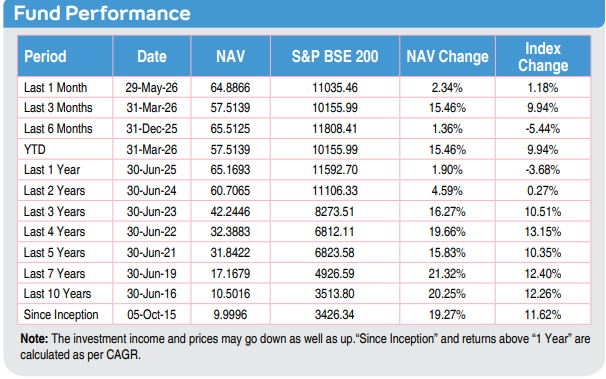
4Data from our Tata AIA fund fact sheet shows the performance of Tata AIA Multi Cap fund & SFIN NO: ULIF 060 15/07/14 MCF110 as on June 2026. Benchmarked with Nifty 50
6The Insured Amount under Terminal Illness with Term Booster option (in Health Buddy) is payable on earlier of death or diagnosis of Terminal illness of the Life Insured. Please refer Terms and Conditions for more details.
7Market-linked returns are subject to market risks and terms & conditions of the product. The assumed rate of returns or illustrated amount may not be guaranteed and depends on market fluctuations.
Linked Life Insurance products are different from traditional insurance products and are subject to risk factors.
The premium paid in Unit Linked Life Insurance policies are subject to investment risks associated with capital markets and the NAVs of the units may go up or down based on the performance of fund and factors influencing the capital market and the insured is responsible for his/her decisions. The various funds offered under this contract are the names of the funds and do not in any way indicate the quality of these plans, their future prospects and returns. On survival to the end of the policy term, the Total Fund Value including Top-Up Premium Fund Value valued at applicable NAV on the date of Maturity will be paid
Tata AIA Life Insurance Company Limited is only the name of the Life Insurance Company & Tata AIA Smart SIP and Tata AIA Smart Sampoorna Raksha Supreme is only the name of the Linked Insurance contract and does not in any way indicate the quality of the contract, its future prospects or returns.
Please know the associated risks and the applicable charges, from your insurance agent or the Intermediary or policy document issued by the insurance company.
The Various funds offered under this contract are the names of the funds and do not in any way indicate the quality of these plans, their future prospects and returns. Premium paid in Unit Linked Life Insurance policies are subject to investment risks associated with capital markets and the NAVs of the units may go up or down based on the performance of fund and factors influencing the capital market and the insured is responsible for his/her decisions.
Buying a Life Insurance policy is a long-term commitment. An early termination of the policy usually involves high costs, and the Surrender Value payable may be less than the all the Premiums Paid. Unit Linked Life Insurance products are different from traditional insurance products and are subject to risk factors.
L&C/Advt/2026/Aug/5000











 Multicap fund delivered 15.83% returns (Benchmark:10.35%)4