














Call us
Call us
 FOR EXISTING POLICY
Have query on premium, payout or any servicing need?
Call us:
 FOR NEW POLICY
Want to buy a new policy online?
FOR NEW POLICY
Want to buy a new policy online?
FOR NEW POLICY (NRIs)
Note: Consent is provided to Tata AIA Life Insurance Company Limited to contact you by calling/giving missed call to the above numbers.
Thank you for sharing your details. To receive a call from Tata AIA Financial Advisor.
reCAPTCHA is not working.
No relevant search results found.
Popular searches
Continue from where you left of

Share


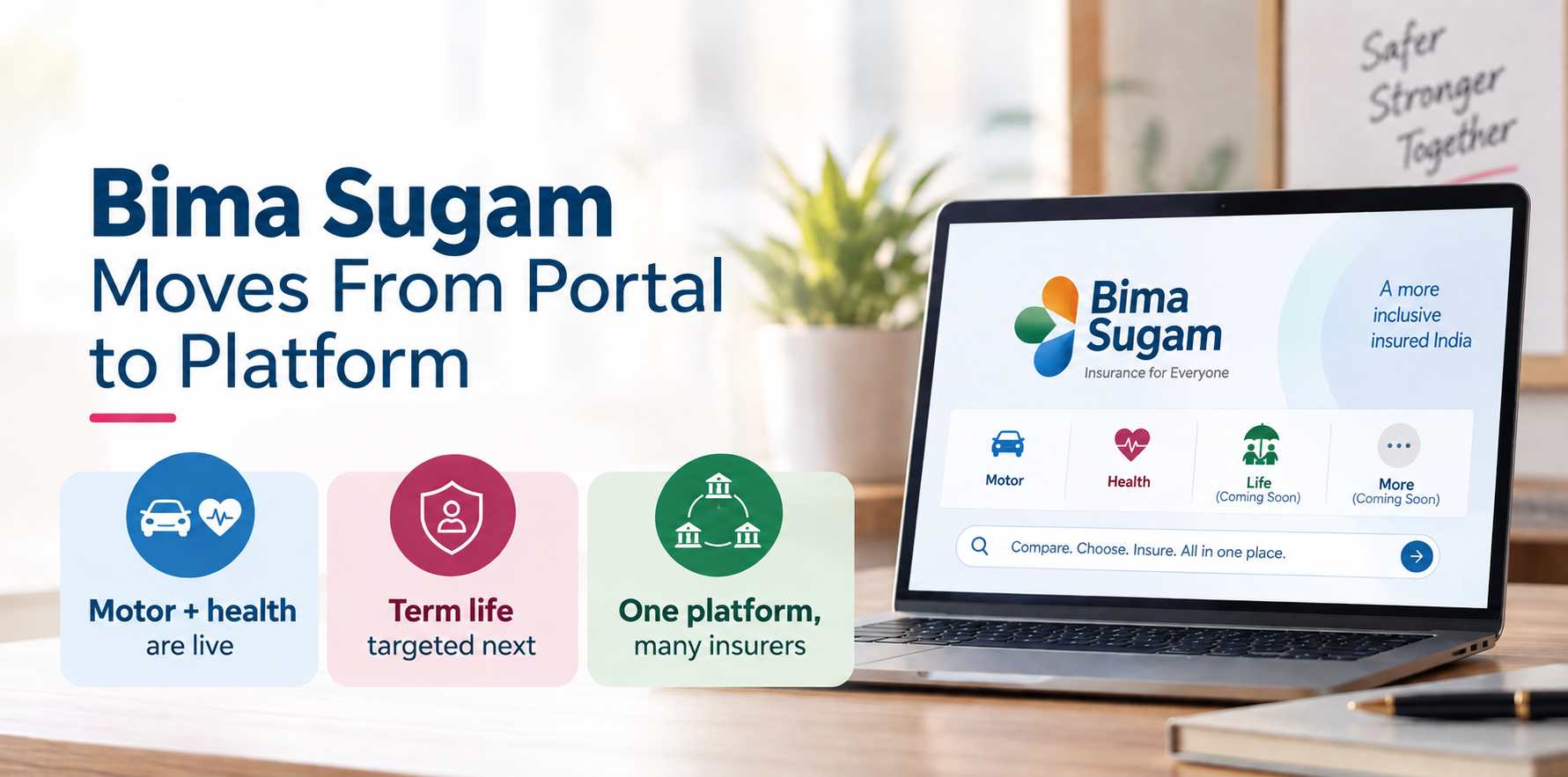
After nearly four years of shifting timelines, Bima Sugam is arriving — not as a single switch-on, but as a sequence. As this edition goes out in mid-September, the platform is partially transactional: motor insurance for new vehicles went live first, motor renewals and health followed, and term life plus full end-to-end functionality are targeted for month-end. Understanding that distinction matters, because the headline “goes live” has been announced before.
Bima Sugam is a unified digital insurance marketplace where customers can eventually discover, compare, buy, renew, service and claim across insurers from one place, instead of moving between insurer apps, agents and aggregator websites. The comparison most often used is UPI: a common set of rails that many institutions plug into, rather than a single company’s storefront.
It is operated by the Bima Sugam India Federation (BSIF), a Section 8 not-for-profit company with authorised capital of ₹500 crore and roughly ₹310 crore paid up. Ownership is deliberately spread across life, general and standalone health insurers so that no single player controls the platform. Its legal basis is the IRDAI (Bima Sugam: Insurance Electronic Marketplace) Regulations, 2024. The platform sits within IRDAI’s wider “Bima Trinity” architecture and its stated objective of Insurance for All by 2047.
Whether the 30 September target for term life and full transactional capability holds. Given the project’s history, a partial go-live is the more probable outcome.
Early adoption rates once buying opens. A comparison portal only compresses distribution costs if customers actually transact on it.
How life insurers respond on product design. Standardised, comparable term products are easy to list; differentiated propositions are harder to display on a price-led marketplace, which raises the value of genuine product innovation.
India’s insurance penetration remains in the region of 4% of GDP against a global average near 7% — the gap the platform is ultimately meant to close.
| Phase | Timing | Scope |
|---|---|---|
Information hub |
September 2025 |
BSIF website live as a guidance and information portal |
Phase 1 |
June–July 2026 |
Motor insurance for new vehicles — the most standardised product |
Phase 2 |
August 2026 |
Motor insurance renewals and health insurance |
Phase 3 |
September 2026 |
Term life insurance; full transactional capability targeted 30 September |
IRDAI Chairman Ajay Seth confirmed the September-end target at the end of June, acknowledging candidly that the project was behind schedule and identifying motor, health and term insurance as the three prioritised products while insurers complete their technology integration. Motor insurers subsequently entered a trial phase. Life and health products have taken longer than motor precisely because fitting them into a single comparable format is harder — and that comparability is the point of the platform.
Registration uses Aadhaar and a mobile number, with e-KYC completed using PAN.
The customer receives a Bima Pehchaan ID — a single insurance identity that links policies held across different insurers.
An e-Bima account acts as one dashboard showing expiry dates, premiums, coverage, claim history and nominee details, with documents stored digitally and synced to DigiLocker.
Linking is not the same as porting. Linking brings an existing policy onto the dashboard while keeping the current insurer; porting moves the cover itself.
The distribution question
The commercial significance sits in the fee structure. Web aggregators and brokers have historically earned commissions that can run as high as 30% of premium on some retail lines. Bima Sugam is expected to charge a platform maintenance fee in the region of 5% to 7%, with IRDAI’s stated intent being to pass the difference to policyholders as lower premiums. That is a meaningful shift in distribution economics.
It is not, however, a removal of intermediaries. Licensed brokers and agents can register on the platform using their IRDAI licence and then manage client portfolios, track renewals and service policies across participating insurers from a single dashboard. IRDAI has consistently framed the platform as enhancing intermediary productivity rather than displacing the channel. A consultation paper on distribution reform forms part of the same reform package.
The wider reform agenda
Bima Sugam is one element of a broader modernisation programme. Alongside it sit the transition to Indian Accounting Standards and a risk-based capital regime, a review of Expenses of Management ratios, and the Policyholders’ Protection and Empowerment Fund, which institutionalises consumer protection, grievance redressal and the tracing of unclaimed insurance amounts. On 1 September 2026, IRDAI released a consultation paper proposing a Public Insurance Registry as digital public infrastructure for the sector, with stakeholder feedback open until 30 September.
| Term | Meaning |
|---|---|
Bima Sugam |
IRDAI-backed unified electronic insurance marketplace for comparing, buying, renewing, servicing and claiming across insurers from a single platform. |
BSIF |
Bima Sugam India Federation — the Section 8 not-for-profit company that builds and operates the platform, jointly owned by insurers. |
Bima Pehchaan ID |
A single digital insurance identity that links a customer’s policies held across different insurers. |
e-Bima account |
The customer dashboard on Bima Sugam showing policies, premiums, expiry dates, claim history and nominee details, with DigiLocker synchronisation. |
Bima Trinity |
IRDAI’s three-part access architecture — Bima Sugam (marketplace), Bima Vistaar (bundled affordable cover) and Bima Vahak (last-mile distribution). |
Insurance penetration |
Total insurance premium as a percentage of GDP. India sits near 4%, against a global average of roughly 7%. |
Web aggregator |
An IRDAI-licensed intermediary that displays and compares products from multiple insurers online and earns commission on policies sold. |
Expenses of Management (EoM) |
A regulatory cap on an insurer’s total operating expenses and commissions as a proportion of premium, used to protect policyholder value. |
Risk-based capital (RBC) |
A solvency framework under which required capital is calibrated to the actual risks an insurer carries, rather than to a flat formula. |
Public Insurance Registry (PIR) |
Digital public infrastructure proposed by IRDAI on 1 September 2026 to hold sector-wide insurance records; consultation open to 30 September 2026. |
Content in this edition was compiled from publicly available reporting and primary institutional material published between June and early September 2026, and cross-referenced across outlets before drafting.
| Section | Principal sources |
|---|---|
Insurance Industry News |
Business Standard (IRDAI Chairman Ajay Seth, 30 June 2026); The Insurance Reporter; Ditto; Vaatun; VahanBazaar; Angel One; NEXT IAS on IRDAI reforms; IRDAI consultation paper on the Public Insurance Registry (1 Sept 2026). |
Need assistance in choosing the right insurance plan?
Get 1 Crore Life Cover + 7% Digital Discount on Year 1 Premium

Our experts are happy to help you!
This blog is for information and illustrative purposes only and does not purport to any financial or investment services and do not offer or form part of any offer or recommendation. The information is not and should not be regarded as investment advice or as a recommendation regarding any particular security or course of action.
Every effort is made to ensure that all information contained in this blog is accurate at the date of publication, however, the Tata AIA Life shall not have any liability for any damages of any kind (including but not limited to errors and omissions) whatsoever relating to this material.

 10 mins read