














Call us
Call us
 FOR EXISTING POLICY
Have query on premium, payout or any servicing need?
Call us:
 FOR NEW POLICY
Want to buy a new policy online?
FOR NEW POLICY
Want to buy a new policy online?
FOR NEW POLICY (NRIs)
Note: Consent is provided to Tata AIA Life Insurance Company Limited to contact you by calling/giving missed call to the above numbers.
Thank you for sharing your details. To receive a call from Tata AIA Financial Advisor.
reCAPTCHA is not working.
No relevant search results found.
Popular searches
Continue from where you left of

Share


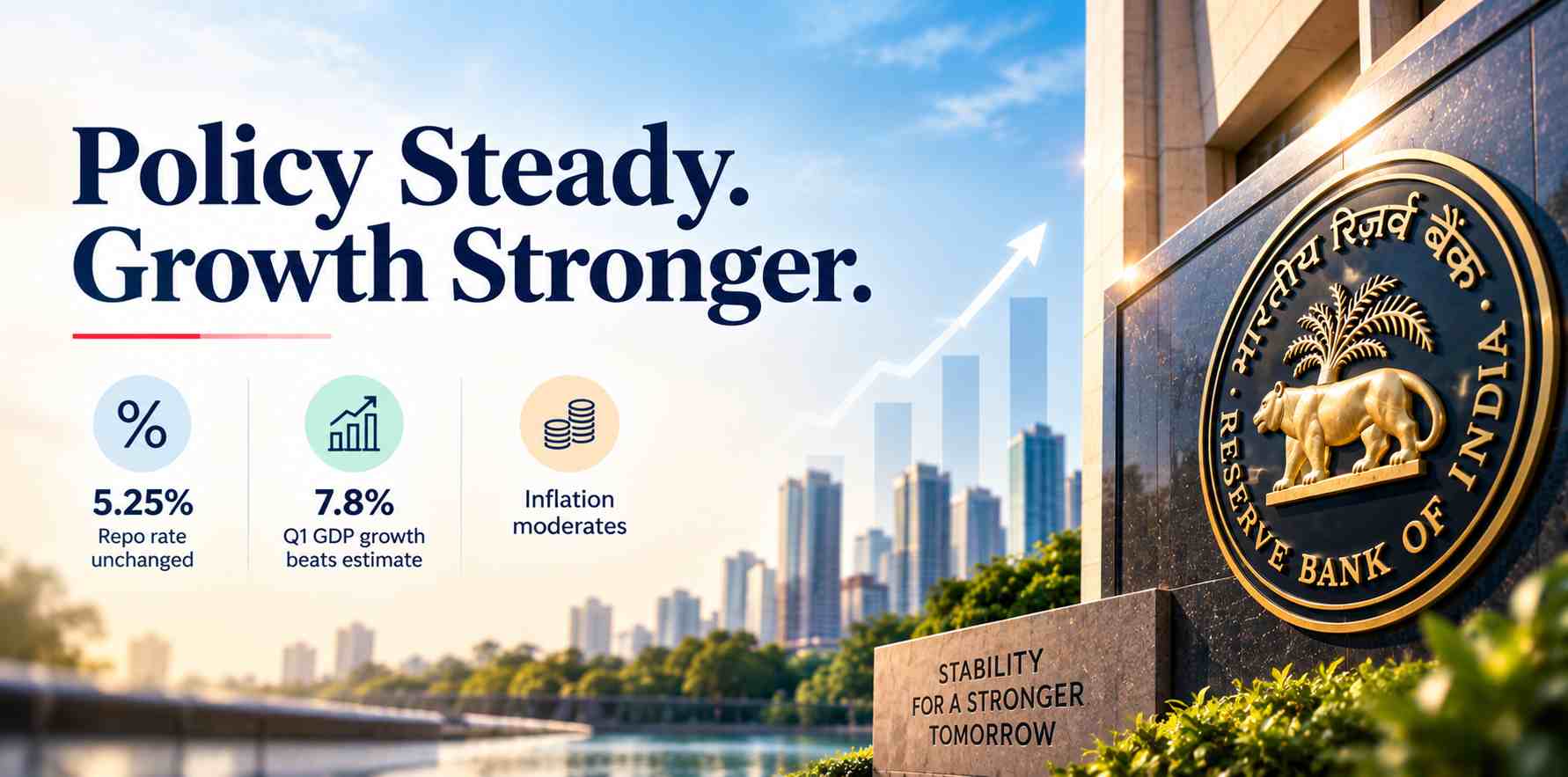
The Reserve Bank of India’s Monetary Policy Committee met from 3 to 5 August 2026 — its third bi-monthly review of FY27 — and voted unanimously to leave the policy repo rate unchanged at 5.25%, retaining a neutral stance. It was the fourth consecutive hold.
| Indicator | August 2026 outcome | Note |
|---|---|---|
Policy repo rate |
5.25% (unchanged) |
Fourth consecutive hold; unanimous 6–0 vote |
Stance |
Neutral (retained) |
Preserves room to move either way |
Standing Deposit Facility (SDF) |
5.00% |
Floor of the interest-rate corridor |
MSF rate and Bank Rate |
5.50% |
Ceiling of the corridor |
FY27 real GDP growth forecast |
6.7% (raised from 6.6%) |
Upward revision despite global stress |
FY27 CPI inflation projection |
5.0% (lowered) |
Within the 2–6% tolerance band |
Cumulative easing still in place |
125 bps of cuts from 2025 |
Easing cycle began February 2025 |
Rate stability gives lenders and insurers clearer visibility on funding costs and product pricing through the festive quarter. Real-estate and housing-finance bodies publicly welcomed the continuity for exactly this reason.
For life insurers, a stable rate environment supports guaranteed-return and non-participating product pricing, where reinvestment risk is the central actuarial concern.
The binding constraint on the next cut is crude, not domestic demand. Watch the oil path in the Global News section above as the leading indicator for the October review.
Governor Sanjay Malhotra pointed to the continuing conflict in West Asia and the resulting disruption to trade routes as sources of external volatility that argued for policy continuity. Domestic inflation was also drifting up rather than down: June CPI came in at 4.38% against 3.93% in May, with food inflation at 5.32%, and July readings were around 4.45%. Inflation remained comfortably inside the RBI’s 2–6% tolerance band, but not at a level that would justify cutting further while crude prices were rising.
In effect, the easing cycle that began in February 2025 is suspended rather than reversed. The 125 basis points of cuts already delivered remain in the system, and further reductions now require a material improvement in both global conditions and the domestic inflation trajectory. A basis point is one hundredth of a percentage point, so 125 basis points equals 1.25 percentage points.
On 31 August the National Statistics Office reported that the Indian economy grew 7.8% in Q1 FY27 — against the RBI’s own projection of 7% for the quarter. Real GDP was estimated at ₹81.36 lakh crore versus ₹75.46 lakh crore a year earlier, while nominal GDP rose 10.3% to ₹88.27 lakh crore. Real Gross Value Added, which measures output net of taxes and subsidies, grew 8.2%.
The composition was encouraging for anyone underwriting corporate or retail credit risk. Manufacturing GVA expanded 9.2% and capital goods production rose 15.2% — the latter a useful forward indicator of private capital expenditure. The secondary sector as a whole grew 8.6%, against 6.1% in the comparable quarter. For context, FY26 real GDP growth was 7.7%.
The gap between forecast and outcome has drawn scrutiny, including questions about the implied GDP deflator of around 2.5% sitting alongside retail inflation near 3.9% and wholesale inflation above 9%. These measures cover different baskets and are not designed to converge, but the divergence is worth noting when reading nominal growth figures.
Polymer banknotes: The Governor confirmed that plastic-based currency notes are expected from the beginning of FY28, subject to field trials. The government has approved printing two billion polymer notes for testing — one billion each of ₹10 and ₹20 denominations. Polymer notes are more durable and harder to counterfeit than paper.
Banking-sector proposals: A set of reform measures aimed at reducing intermediation costs and improving operational efficiency was placed alongside the policy statement.
FCNR(B): The RBI clarified there is no proposal to end the Foreign Currency Non-Resident (Bank) deposit scheme early.
| Term | Meaning |
|---|---|
Monetary Policy Committee (MPC) |
The six-member RBI committee that sets the policy interest rate. It meets bi-monthly and votes; decisions and voting patterns are published. |
Repo rate |
The rate at which the RBI lends short-term funds to commercial banks against government securities. It anchors lending and deposit rates across the system. |
Standing Deposit Facility (SDF) |
The rate at which the RBI absorbs surplus bank liquidity without collateral. It forms the floor of the interest-rate corridor. |
Marginal Standing Facility (MSF) |
The rate at which banks can borrow from the RBI overnight in stress. With the Bank Rate, it forms the ceiling of the corridor. |
Neutral stance |
Forward guidance signalling that the RBI is not committed to either raising or lowering rates next, and will act on incoming data. |
Basis point (bps) |
One hundredth of a percentage point. 125 bps equals 1.25 percentage points. |
CPI inflation |
Consumer Price Index inflation — the retail price measure the RBI targets, at 4% with a tolerance band of 2% to 6%. |
Gross Value Added (GVA) |
Output measured net of taxes and subsidies on products. GVA shows production-side activity; GDP adds net product taxes. |
GDP deflator |
The implied economy-wide price change derived from the gap between nominal and real GDP. It covers a different basket from CPI or WPI, so the three do not match. |
FCNR(B) |
Foreign Currency Non-Resident (Bank) deposits — foreign-currency term deposits held with Indian banks, mainly by non-resident Indians. |
Content in this edition was compiled from publicly available reporting and primary institutional material published between June and early September 2026, and cross-referenced across outlets before drafting.
| Section | Principal sources |
|---|---|
India News |
RBI August 2026 monetary policy statement as reported by Forbes India, Outlook Money and Business Standard; CMI & Co India newsletter (August 2026); MoSPI Q1 FY27 GDP release (31 Aug 2026); Polymer notes, The Hindu. |
Need assistance in choosing the right insurance plan?
Get 1 Crore Life Cover + 7% Digital Discount on Year 1 Premium

Our experts are happy to help you!
This blog is for information and illustrative purposes only and does not purport to any financial or investment services and do not offer or form part of any offer or recommendation. The information is not and should not be regarded as investment advice or as a recommendation regarding any particular security or course of action.
Every effort is made to ensure that all information contained in this blog is accurate at the date of publication, however, the Tata AIA Life shall not have any liability for any damages of any kind (including but not limited to errors and omissions) whatsoever relating to this material.

 10 mins read