


















Call us
Call us
 FOR EXISTING POLICY
Have query on premium, payout or any servicing need?
Call us:
 FOR NEW POLICY
Want to buy a new policy online?
FOR NEW POLICY
Want to buy a new policy online?
FOR NEW POLICY (NRIs)
Note: Consent is provided to Tata AIA Life Insurance Company Limited to contact you by calling/giving missed call to the above numbers.
Thank you for sharing your details. To receive a call from Tata AIA Financial Advisor.
reCAPTCHA is not working.
No relevant search results found.
Your details have been successfully submitted. A representative from Tata AIA Life Insurance will call you soon.
Your details could not be saved.
Please try again.
Kindly enter the OTP sent to
Please enter valid OTP
01:60
Didn't receive OTP?
Technical issue detected- please continue without OTP verification
Your premium calculation is in progress
₹1 Crore
4% and 8% are assumed rates of return. Tata AIA Multi Cap Fund Returns since inception: 21.22% (Benchmark: 13.33%) as of Jun'25
by paying a premium of ₹21,749/month (for 5 years)
| Fund Name | 5 Year Returns |
Benchmark Returns |
Benchmark Name |
|---|---|---|---|
| Multi Cap Fund | 30.63% | 21.62% | S&P BSE 200 |
| Top 200 Fund | 31.38% | 21.62% | S&P BSE 200 |
| India Consumption Fund | 29.57% | 21.62% | S&P BSE 200 |
Our sales representative will connect with you soon to assist further
Param Raksha Life Pro +. This advertisement is designed for combination of benefits of following individual and separate products named (1) Tata AIA Smart Sampoorna Raksha Supreme Unit Linked, Non-Participating Individual Life Insurance Plan (UIN: 110L179V02) and (2) Tata AIA Health Buddy, Non-Participating, Non-Linked, Individual Health Product (UIN: 110N183V01). These products are also available for sale individually without the combination offered/suggested. This benefit illustration is the arithmetic combination and chronological listing of combined benefits of individual products. The customer is advised to refer the detailed sales brochure of respective individual products mentioned herein before concluding sale.
Investment Calculator
Tata AIA Multi Cap Fund is one of the many funds under the equity portfolio of Tata AIA Fund Assure. A multi-cap fund invests mainly in the equity and equity related instruments of large-capitalisation, mid-capitalisation, and small-capitalisation companies.
When you buy a Tata AIA Life Insurance Unit-Linked Insurance Plan, you can choose to invest in the Tata AIA Multi Cap Fund as per your investment goals.
In this policy, the investment risk in investment portfolio is borne by the policyholder
TATA AIA Funds Have Delivered Benchmark Beating Performance |
||||
|
Last 5 Years Returns8 |
Since Inception9 Returns |
||
Tata AIA Funds |
Fund Return (%)6 |
Benchmark Return (%)6 |
Fund Return (%)7 |
Benchmark Return (%)6 |
Multi Cap Fund |
Not Applicable |
91 Days - 17 Years |
91 Days - 17 Years |
91 Days - 17 Years |
Top 200 Fund |
Not Applicable |
91 Days - 17 Years |
91 Days - 17 Years |
91 Days - 17 Years |
India Consumption Fund |
Not Applicable |
91 Days - 17 Years |
91 Days - 17 Years |
91 Days - 17 Years |
8Data as of December 31, 2024. Past performance is not indicative of future performance. • Fund Benchmark: Multi Cap Fund – S&P BSE 200; India Consumption Fund - S&P BSE 200; Top 200 Fund - S&P BSE 200. • SFIN: Multi Cap Fund – ULIF 060 15/07/14 MCF 110; Top 200 Fund - ULIF 027 12/01/09 ITT 110; India Consumption Fund - ULIF 06115/07/14 ICF 110. 9Inception Dates: Top 200 Fund: 12 Jan 2009, Multi Cap Fund: 05 Oct 2015, India Consumption Fund: 05 Oct 2015.
These are some of the benefits of the Tata AIA Multi Cap Fund
Investing in this fund offers exposure to all market segments. This diversification aids in reducing portfolio risk, which can maximise investor returns. Fund managers are able to explore better investment avenues since they need not rely solely on single market capitalisation.
The Tata AIA Multi Cap Fund has been known to offer optimal returns since its inception. Through the fund performance, investors can gauge and analyse the fund manager’s strategies and the trend of the multi-cap fund.
Tata AIA Multi Cap Fund has been rated 5 Star2 by Morningstar3 as of December 31, 2024. A 5-star rating indicates that a fund has been among the market’s top performers in terms of risk-adjusted return.
This fund aims to generate long-term capital appreciation, which can help investors in two ways. Long-term investment can help an investor brace their investments against market volatility while simultaneously benefiting from the power of compounding.
Long-Term Investors
Tata AIA Health Buddy provides financial support in case of death due to an accident to help your family during the difficult time.
First Time Investors
We also offer a return of balance premium option, which refunds the 'Total Premiums Paid' (excluding modal premium loading), minus any claims paid under the benefit option and any premium discounts or cashback earned through the wellness program, as applicable in T&C.
Diversified Portfolio Seekers
Investors who are looking to diversify their portfolio across different sectors and market capitalizations without having the worry to manage multiple funds.
Financial Goal Seekers
Investors who are planning for fulfilling long-term financial goals such as securing one’s retirement, fund their children's education, or buying a home.
Our experts are happy to help you!
Our experts are happy to help you!
The asset allocation of different companies which make up the portfolio of the Tata AIA Multi Cap Fund are given below:
Instrument |
% Of NAV |
Instrument |
% Of NAV |
Equity |
95.99 |
Concord Biotech Ltd |
1.98 |
HDFC Bank Ltd |
5.60 |
Max Financial Services Ltd |
1.96 |
Interglobe Aviation Ltd |
5.21 |
IndusInd Bank Ltd. |
1.93 |
Infosys Ltd. |
5.08 |
Delhivery Ltd |
1.86 |
ICICI Bank Ltd. |
4.60 |
Shyam Metalics and Energy Ltd |
1.84 |
MCX of India Ltd. |
3.89 |
Mphasis Ltd. |
1.75 |
BSE Ltd |
3.87 |
Finolex Cables Ltd. |
1.70 |
Reliance Industries Ltd. |
3.25 |
Jindal Stainless Ltd. |
1.69 |
Zomato Ltd |
2.63 |
Axis Bank Ltd. |
1.62 |
Mankind Pharma Ltd |
2.48 |
Prudent Corporate Advisory Services Ltd |
1.56 |
Trent Ltd. |
2.45 |
Aurobindo Pharma Ltd. |
1.54 |
Tata Motors Ltd. |
2.24 |
Bharti Airtel Ltd. |
1.46 |
Power Finance Corporation Ltd. |
2.16 |
Wipro Ltd. |
1.45 |
Mahindra and Mahindra Ltd. |
2.14 |
Other Equity |
25.93 |
Voltas Ltd. |
2.10 |
MMI & Others |
4.01 |
|
|
Total |
63.7161 |
1. What are multi-cap funds?
A multi-cap fund invests in large-cap, mid-cap, and small-cap companies, which enables diversification in its portfolios across all market capitalisations.
2. Are multi-cap funds safe?
Multi-cap funds invest in equities. If investing in multi-cap funds, ensure that your risk profile matches the portfolio risk.
3. Who should invest in a multi-cap fund?
Investors seeking long-term capital appreciation through investment in equities and wanting to invest in large-cap, mid-cap and small-cap companies can choose a multi-cap fund. One should also select a multi-cap fund if their capacity for risk matches the risk profile of the multi-cap fund.
4. Which is better, large-cap or multi-cap?
The choice between a large-cap or multi-cap fund will depend on the investor’s risk profile. An investment in a large-cap fund is considered less risky than a multi-cap fund investment. However, multi-cap funds allow greater diversification across market capitalisations and help generate long-term capital appreciation.
5. How do I choose a multi-cap fund?
These are the following points to consider while choosing a multi-cap fund: ● Since multi-cap funds invest in mid, small, and large-cap equities, they can be riskier than large-cap funds. Hence, investors whose risk tolerance matches the fund's risk profile may find multi-cap funds suitable. ● Multi-cap funds are meant to be long-term investments as they aim to offer long-term capital appreciation. You may consider a multi-cap fund if you are looking for a long-term investment in equities. ● Check the past performance of the multi-cap fund you want to invest in. Over the last 5 years, if the fund has performed well and offered steady returns, you can consider investing in it.
6. What is the fund switch facility?
The fund switch facility provided in Tata AIA Life Insurance ULIPs allow the investor to switch from one fund to another if the existing choice of funds does not meet the investor’s expectations. Tata AIA Life Insurance offers switching of funds for a policy year as per policy condition, during which the investor can move to other funds as and when needed.
7. How to check the fund NAV?
You can check our funds’ Net Asset Value (NAV) here. This is important for ULIP policyholders who have selected certain funds to invest in under their policy.
Just select the name of the fund and the time period to view the daily NAV. For instance, if you have invested in the Tata AIA Multicap Fund, you can select Tata AIA Multicap Fund in the dropdown.
8. What is the right time to buy a ULIP?
You can buy a ULIP when you have the financial capacity to start an investment and know how investments work. Since ULIPs combine life insurance and investment under the same policy, it is also advisable to purchase the policy in your 20s or early 30s so that the premium cost is reasonable and affordable. As you grow older, the premium amount will also increase.
9. How much can I invest in a ULIP?
The amount you want to invest in your ULIP will depend on your financial capacity, investment goals, and risk capacity. You can either pay the minimum annualised premium or choose an amount up to the maximum annualised premium limit as per your choice.
10. Where can I check my policy fund value?
If you have a Unit Linked Insurance Plan (ULIP) with Tata AIA Life Insurance, you can check the fund value by logging in to My DigiAccount. Click here.
11. Where can I check the other funds of Tata AIA Life Insurance?
Follow below steps:
● Visit our Fund Fact sheet corner on Tata AIA website ● Select year and month to download the fund factsheet ● View details of all the funds along with their objective and performance
12. Where can I check the other funds of Tata AIA Life Insurance?
There are three main benefits of diversifying an investment portfolio:
● Firstly, with a diversified portfolio, your investment portfolio risk will not only be minimised but will also be able to withstand market volatility ● Secondly, not all investments and asset classes perform the same at any point in time. A combination of different investments will allow your investment to grow as per the performing asset classes and eliminate the need for constantly monitoring the portfolio ● Lastly, many investments grow on the principle of compound interest. When making a long-term investment with a diversified portfolio, all your investments can benefit from the power of compounding and enable optimal returns.
13. What does asset allocation mean?
As an investment strategy, asset allocation distributes the funds of a portfolio in different proportions into various asset classes. This is done to balance or maintain the risk profile of the investment.
Suppose an investment portfolio is being realigned as per an investor’s risk profile, investment goals and investment horizon. In that case, the asset allocation across different asset classes will be carried out to match the investor’s needs. Some may need to invest more in equities, while others may opt for greater asset allocation in debt instruments.
New user? Our experts are happy to help.
Thank you for sharing your details.
Our representative will contact you soon.









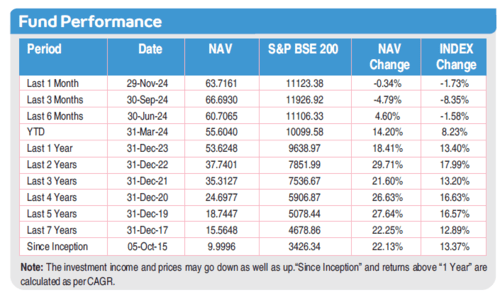
 Multi cap Fund delivered 27.64% Returns (Benchmark: 16.57%)1