
















Call us
Call us
 FOR EXISTING POLICY
Have query on premium, payout or any servicing need?
Call us:
 FOR NEW POLICY
Want to buy a new policy online?
FOR NEW POLICY
Want to buy a new policy online?
FOR NEW POLICY (NRIs)
Note: Consent is provided to Tata AIA Life Insurance Company Limited to contact you by calling/giving missed call to the above numbers.
Thank you for sharing your details. To receive a call from Tata AIA Financial Advisor.
reCAPTCHA is not working.
No relevant search results found.
Popular searches
Continue from where you left of
A term insurance plan provides financial protection to your family in case of your untimely demise. It offers a high life cover at an affordable premium,... Read more making it a practical option for long-term financial planning. You can also customise your policy by adding optional riders8 based on your protection needs. This article covers the key term insurance benefits.Read less
Your premium calculation is in progress

Kindly enter the OTP sent to
Please enter valid OTP
01:60
Didn't receive OTP?
Your details have been successfully submitted. A representative from Tata AIA Life Insurance will call you soon.
Your details could not be saved.
Please try again.
Get Life Cover of ₹1 Crore by paying a premium of
₹7,085/month
Total premium: ₹14.09 Lakh

 Save ₹1,202 with discounts
Discounts
10% discount on 1st year premium is applicable on online purchase. This discount is auto-applied and can’t be removed
8.5% discount on 1st year premium is applicable for salaried personnel. You will need to share your corporate email ID if you opt for this discount. This discount is auto-applied if you select ‘Salaried’ as your occupation and can’t be removed
Applicable only if the policy is bought digitally. Some discounts will not be available when this option is selected.
1% discount on 1st year premium for all payments paid through any permissible electronic mode debited through an auto-debit mandate. Maximum discount capping: ₹100 over the year.
2% discount on 1st year premium on these milestones
| Event | Eligibility |
|---|---|
| Wedding (1 wedding only) | Within 6 months before or after the date of wedding |
| Birth/ Adoption of 1st child* | Within 6 months before or after the birth/ adoption date |
| Home loan | Within 6 months of loan getting sanctioned |
| First job | Within 6 months of joining date |
*Policy issuance eligibility for female customers will be determined by Board Approved Underwriting Policy (BAUP)
The above milestones cannot be clubbed to avail more discount, Such discount shall be capped to a maximum of ₹500 over the year.
Tata AIA Sampoorna Raksha Promise - Non-Linked, Non-Participating, Pure Risk, Individual Life Insurance Product (UIN: 110N176V12)
Rated by 1,41,770 customers
Data as of 14th October 2026, 4.7/5 from 1.41 Lakh+ ratings across Android and iOS Tata AIA app.
120 year old female (Standard Life, Non-Smoker), regular pay, 20 year policy term
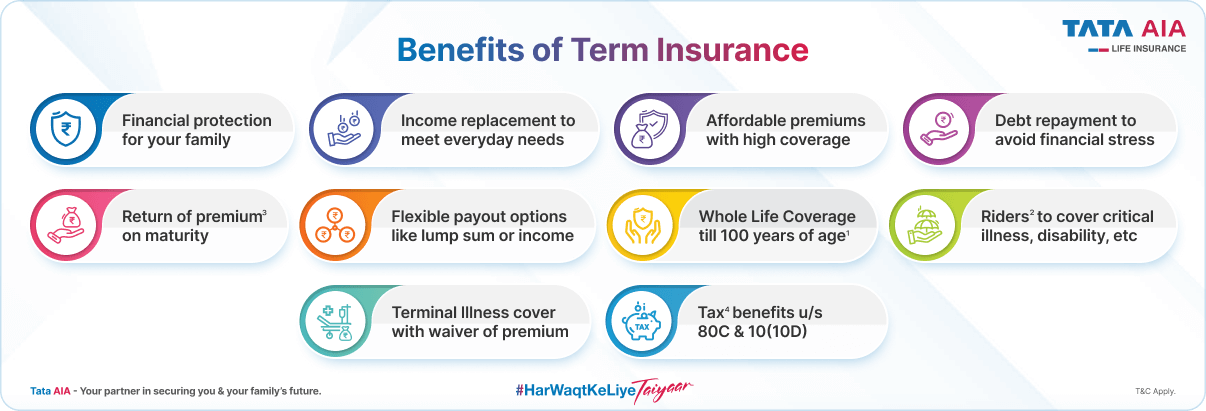
Term insurance offers a wide range of benefits that make it a vital component of financial planning. Below are the term insurance benefits:
Tata AIA
Non-Linked, Non-Participating, pure risk, Individual Life Insurance Product (UIN:110N176V13)
Tata AIA
Non-Linked, Non-Participating, Pure Risk, Individual Life Insurance Product (UIN: 110N171V16)
If you purchase the plan early in life you can avail the following term life insurance benefits:
Term insurance is a cost-effective way to secure your family's financial future. Here’s how it offers protection and stability during uncertain times:
If you are the sole or primary earning member, your family depends on your income to manage daily living expenses. In the unfortunate event of your demise, a term insurance policy provides a lump sum benefit to your nominee. This sum helps your family pay for expenses like rent, groceries, and school fees by replacing your lost income. It ensures that, even when you're not around, they continue to live comfortably. For those who wish to protect their family's financial future from the possibility of income loss, term insurance may be quite appropriate.
Many people have debts, including personal, vehicle, and home loans. Your family might find it difficult to pay back these debts if you pass away unexpectedly. Benefits from a term life insurance policy could lessen this load. By using the policy payout to pay off outstanding debts, your family won't have to liquidate assets or take out new loans. As a result, your loved ones will have peace of mind and financial stability.
You should purchase a term insurance policy that has all the features and benefits you need, along with a lower premium. Ideally, your coverage should equal or exceed 10–15 times your annual income. As an example, if your income is around Rs 15 lakh per year, a suitable life insurance policy would range between Rs 1.5 crore and Rs 2.25 crore. For enhanced protection, individuals with higher financial responsibilities or goals may also consider a Rs 5 crore term insurance plan.
Unforeseen life events can lead to financial instability for your family in your absence. In such a case, a term insurance plan benefits by offering long-term financial security. Here are some key reasons to consider buying one:
Selecting the right term insurance policy involves evaluating your financial responsibilities, future goals, and coverage requirements. Let’s understand how to choose the best term insurance policy:
Our experts are happy to help you!
Our experts are happy to help you!
A term insurance plan is one of the simplest ways to strengthen your family's financial security against life's uncertainties. From affordable premiums and flexible coverage to optional riders8 and tax benefits5, it offers protection that can be tailored to different financial needs. Choosing the right plan after carefully assessing your income, responsibilities, and long-term goals can help ensure your loved ones remain financially supported, while giving you greater confidence about their future.
Tata AIA Sampoorna Raksha Promise - Non-Linked, Non-Participating, pure risk, Individual Life Insurance Product (UIN:110N176V13)
Tata AIA Maha Raksha Supreme Select - Non-Linked, Non-Participating, Pure Risk, Individual Life Insurance Product (UIN: 110N171V16)
1Illustrated premium of ₹678 is the monthly premium excluding taxes for a 20 yr. old female, Standard Life, Non-Smoker for ₹1.5 Cr. Sum Assured with Policy Term of 20 yrs. (Regular Pay) under Life Promise Option of Tata AIA Sampoorna Raksha Promise with first year premium discount of 10% for digital purchase and 8.5% for salaried person. Please refer Benefit Illustration for more details.
2Under Life Promise Plus Option, an amount equal to the 100% of the Total Premiums Paid (excluding loading for modal premiums) shall be payable at the end of the Policy Term, provided the life assured survives till maturity and the policy is not terminated earlier.
3Applicable to only non-early claims with more than 3 years of policy duration, non-investigation cases, up to Sum Assured of ₹50 Lakh. Applicable for branch walk in. Time limit to submit claim to Tata AIA Life Insurance is 2 pm on working days. Subject to submission of complete documents. Not applicable for ULIP policies and open title claims.
4Not applicable under PoS, please refer sales brochure for more information
5Tax benefits of up to ₹46,800 u/s 80C is calculated at highest tax slab rate of 31.20% (including cess excluding surcharge) on life insurance premium paid of ₹1,50,000 as per old tax regime. Tax benefits under the policy are subject to conditions laid under Section 80C, 80D,10(10D), 115BAC and other applicable provisions of the Income Tax Act,1961. The Tax-Free income is subject to conditions specified under section 10(10D) and other applicable provisions of the Income Tax
Act,1961. Tax laws are subject to amendments made thereto from time to time. Please consult your tax advisor for details, before acting on above
No Goods and Service Tax shall be applicable on Individual life insurance products as per prevailing laws. Tax laws are subject to amendments from time to time. If any imposition (tax or otherwise) is levied by any statutory or administrative body under the Policy, Tata AIA Life Insurance Company Limited reserves the right to claim the same from the Policyholder.
6This includes first year digital discount of 10% for Limited Pay/Regular Pay and 8.5% salaried discount. For Single Pay, 1% discount will be available for online purchase and salaried discount each.
7Illustrated Premium of ₹683 is the monthly premium excluding taxes for 20 yr. old female, Standard Life, Non-Smoker for 2 Cr. Sum Assured with Policy Term of 20 yrs. (Regular Pay) with Life Secure plan option of Tata AIA Maha Raksha Supreme Select with first year premium discount for digital purchase and salaried person.
8Rider is not mandatory and is available for a nominal extra cost. For more details on benefits, premiums, and exclusions under the Rider, please contact Tata AIA Life's Insurance Advisor/ branch.
This product is underwritten by Tata AIA Life Insurance Company Ltd.
The plan is not a guaranteed issuance plan, and it will be subject to company’s underwriting and acceptance.
Insurance cover is available under this product.
For more details on risk factors, terms and conditions please read sales brochure carefully before concluding a sale. The precise terms and condition of this plan are specified in the Policy Contract.
Buying a Life Insurance Policy is a long-term commitment. An early termination of the Policy usually involves high costs, and the Surrender Value payable may be less than the all the Premiums Paid.
In case of non-standard lives and on submission of non-standard age proof, extra premiums will be charged as per our underwriting guidelines.
L&C/Advt/2026/Sep/5036













 Written by


 Reviewed by